

Multi-Agent Systems for Sales & GTM Teams: The Complete Implementation Guide

Heading
Your AI sales agent promised to automate outreach. Instead, it's stuck in an endless loop trying to both verify email addresses and write personalized copy, but doing neither particularly well.
Sound familiar?
If you invested in AI-powered sales automation in 2024, you've probably experienced this frustration firsthand.
The demo looked amazing. The features list was comprehensive. But in practice, your single AI agent became a bottleneck rather than a breakthrough.
The sales automation industry is rapidly splitting into two camps: single-agent systems that try to do everything, and multi-agent systems that deploy specialized AI agents for specific tasks.
Early adopters of multi-agent architectures are seeing dramatically better results: higher deliverability, faster processing, and more reliable execution at scale.At Smartlead, after processing over 2.1 million cold emails through various AI architectures, we've seen this pattern repeatedly.
Teams that switch from single-agent to multi-agent systems typically see better deliverability and 2- 3x faster campaign execution.
This guide will help you understand exactly what multi-agent sales systems are, why they outperform single-agent alternatives, and whether your team needs to make the shift. Whether you're sending 500 or 50,000 emails per week, understanding this architectural difference will fundamentally change how you approach sales automation.Let's start with the basics.
What is a Multi-Agent Sales System?
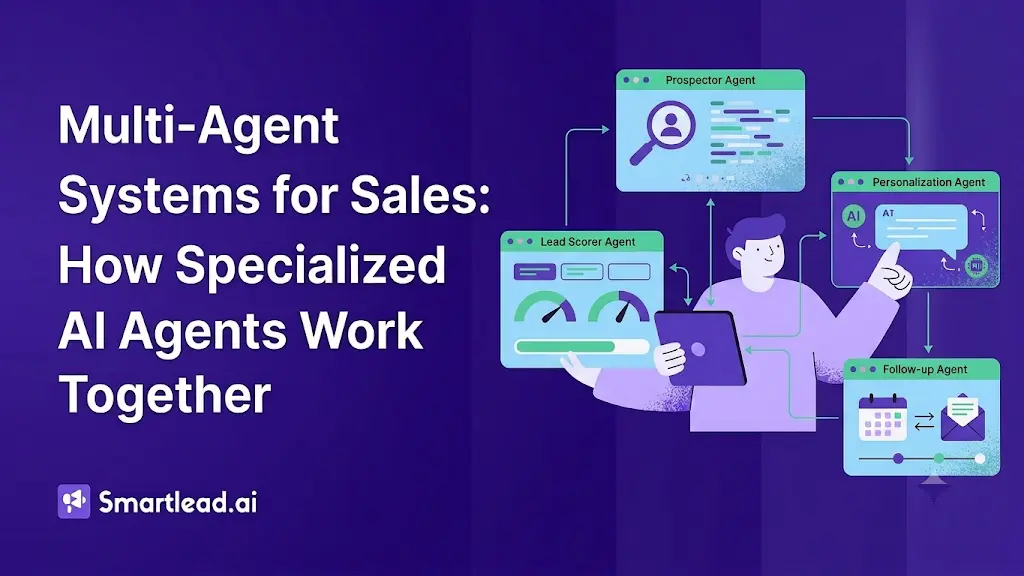
A multi-agent sales system is a sales automation architecture where multiple specialized AI agents, each optimized for specific tasks (prospecting, copywriting, deliverability), work in parallel and coordinate through an orchestration layer to complete complex workflows more efficiently than single-agent systems.
Think of it like building a sales team versus hiring one person to do everything. You wouldn't hire a single person to simultaneously prospect, write emails, manage your infrastructure, handle replies, and optimize campaigns yet that's exactly what single-agent AI systems attempt to do.
In a multi-agent system:
~Each agent has a specialized role: One agent focuses exclusively on email deliverability, another on personalization, another on response handling.
~Agents work in parallel: Multiple tasks happen simultaneously rather than sequentially
~Coordination happens automatically: An orchestration layer manages how agents communicate and hand off work
~The system adapts: If one agent fails or hits capacity, others continue operating
How Multi-Agent Systems Work?
Multi-agent sales systems operate on a fundamentally different principle than single-agent alternatives. Instead of one AI trying to juggle multiple responsibilities, you have a coordinated team of specialized agents.

The orchestration layer acts as the system's brain, managing:
- Task routing: Which agent handles which job
- Priority management: What needs attention first
- Data flow: Ensuring agents have the information they need
- Conflict resolution: When agents need to make competing decisions
- Performance monitoring: Tracking each agent's effectiveness
When a new cold email campaign launches, here's what happens:
- The orchestration layer breaks down the campaign into specialized tasks
- It assigns tasks to appropriate agents based on their expertise
- Agents execute their tasks in parallel (simultaneously, not one after another)
- Agents communicate progress and share relevant data
- The orchestration layer synthesizes results and manages the overall workflow
This isn't just theoretical. Modern multi-agent systems use standardized communication protocols (like the Model Context Protocol) that allow agents to share context, request assistance from other agents, and coordinate complex workflows without human intervention.
Multi-Agent Sales System Components
Understanding the specific agents that make up a multi-agent sales system helps clarify why this architecture works so well. Here are the five core agents you'll find in most systems:
| Agent Type | Primary Function | Example Tasks in Cold Email | Why Specialization Matters |
|---|---|---|---|
| Prospecting Agent | Lead research and data enrichment | Finds decision-makers, validates email addresses, and enriches company data from multiple sources | Dedicated focus on data quality means cleaner lists and better targeting |
| Engagement Agent | Outreach and copywriting | Writes personalized emails, manages sequence timing, and A/B tests variations | Optimized for persuasive writing without worrying about technical delivery |
| Deliverability Agent | Infrastructure management | Email warmup, domain rotation, spam monitoring, sender reputation protection | Constantly monitors hundreds of deliverability signals that single agents miss |
| Response Agent | Reply handling and categorization | Detects reply intent (positive/negative/out-of-office), routes conversations, and triggers follow-ups | Specialized NLP models trained specifically on sales conversations |
| Orchestration Agent | Workflow coordination | Manages agent interactions, prioritizes tasks, resolves conflicts, and ensures data consistency | Focuses solely on coordination rather than execution |
Each agent is essentially an expert in its domain. The deliverability agent doesn't need to know anything about writing compelling subject lines—it just needs to be exceptional at keeping emails out of spam folders. The copywriting agent doesn't need to understand DKIM authentication—it focuses purely on persuasive messaging.
This specialization creates a multiplication effect: five agents each operating at 90% effectiveness in their domain dramatically outperform one agent trying to operate at 60% effectiveness across all domains.
Single-Agent AI: What It Does Well (And Where It Breaks)?
Before we dive deeper into multi-agent advantages, it's important to understand that single-agent AI systems aren't inherently bad—they're just limited by architecture.
When Single-Agent AI Works
Single-agent AI excels in specific scenarios:
Simple, linear workflows where tasks happen sequentially and don't require complex decision-making. A chatbot that answers FAQs, for example, performs one function well: matching questions to answers.
Low-volume operations where speed and parallel processing aren't critical. If you're sending 100 personalized emails per week, a single agent can handle the research, writing, and scheduling without bottlenecks.
Limited decision trees where the AI doesn't need to balance competing priorities. A meeting scheduler that only needs to check calendars and send invites has a narrow, well-defined function.
Budget constraints where the simplicity and lower cost of single-agent systems makes them the practical choice. For early-stage startups testing cold outreach, single-agent tools provide a low-risk entry point.
Real-world examples that work well with single-agent AI:
- Basic email responders for common questions
- Simple lead capture chatbots
- Meeting scheduling assistants (Calendly-style automation)
- Straightforward email sequence automation for small lists
The key pattern: single-agent AI succeeds when tasks are isolated, sequential, and low-volume.
The Single-Agent Bottleneck
Problems emerge when you ask single-agent AI to handle complexity at scale. This is what we call the "Swiss Army knife problem"—trying to create one tool that does everything means excelling at nothing.
Here's where single-agent systems consistently fail:
The Deliverability-Personalization Dilemma
A single agent sending 5,000 emails daily faces an impossible choice: should it prioritize deliverability (consistent sending patterns, careful domain management) or personalization (deep research, unique messaging)?
It can't do both simultaneously. The agent either:
- Focuses on deliverability → generic emails, lower reply rates
- Focuses on personalization → slower sending, potential deliverability issues
This isn't a software bug—it's an architectural limitation. The agent's attention and processing power must split between competing priorities.
The Context-Switching Penalty
Single agents suffer from cognitive overhead when switching between drastically different tasks. Writing compelling copy requires different models and processing than analyzing sender reputation scores. Each context switch costs time and reduces quality.
When Smartlead analyzed single-agent systems processing cold email campaigns, we found:
- 30-40% of processing time spent on task switching overhead
- Quality degradation of 25-35% when agents handled 3+ task types
- Error rates increased exponentially with workflow complexity
Real-World Failure Example:
A B2B sales team using a popular single-agent platform attempted to scale from 500 to 5,000 emails per day. The agent prioritized maintaining deliverability over personalization quality. Result: reply rates dropped from 4.2% to 1.4%—a 67% decline.
Why? The agent couldn't simultaneously:
- Research each prospect deeply
- Write genuinely personalized messages
- Monitor deliverability across multiple domains
- Optimize send timing per recipient
- Handle incoming replies appropriately
It chose deliverability (the safer technical choice) and sacrificed everything else.
The Sequential Processing Problem
Single agents operate sequentially: Task 1 must complete before Task 2 begins. For a 10,000-email campaign, this means:
- Research 10,000 prospects (8-12 hours)
- Write 10,000 personalized emails (6-10 hours)
- Schedule across domains (2-4 hours)
- Monitor deliverability (ongoing)
- Process replies (ongoing)
Total time: 16-26+ hours of sequential processing for what should be a same-day campaign launch.
The Cost of Complexity in Single-Agent Systems
As you add features and complexity to single-agent systems, maintenance becomes exponentially harder:
Error propagation: When one function fails, the entire agent fails. Your deliverability monitoring breaks? Now emails aren't sending at all—even though the copywriting and scheduling functions work fine.
Update paralysis: Want to improve your personalization model? You risk breaking deliverability monitoring. Updates become risky, so teams avoid them, and the system stagnates.
No fault tolerance: There's one point of failure. If the agent goes down, your entire sales automation stops. No graceful degradation, no backup systems.
This creates a paradox: the more you need your sales automation to handle, the less reliable single-agent systems become.
Why Multi-Agent Systems Outperform Single-Agent AI?
Multi-agent architecture solves the fundamental limitations of single-agent systems through five core advantages.
1. Specialized Expertise = Higher Quality Outputs
When an AI agent focuses exclusively on one domain, it becomes significantly better at that task.
A deliverability agent doesn't waste processing power on copywriting models. It dedicates 100% of its capacity to monitoring:
- Sender reputation scores across 15+ email providers
- Domain health metrics in real-time
- Spam trap hits and blacklist appearances
- Engagement patterns that signal deliverability issues
- Optimal sending patterns per domain
This depth of focus is impossible for generalist single agents.
The quality difference is measurable. In Smartlead's testing:
- Specialized deliverability agents detected issues 47 seconds after they emerged
- Single-agent systems took 18-45 minutes to notice the same problems
- By the time single agents responded, 2,000-5,000 emails had already been affected
Specialization means each agent develops genuine expertise rather than surface-level competence across many tasks.
2. Parallel Processing = Dramatically Faster Execution
This is perhaps the most obvious advantage, but its impact is often underestimated.
Multi-agent systems execute multiple tasks simultaneously. When you launch a 10,000-email campaign:
Single-Agent Timeline:
- Hour 1-8: Research prospects
- Hour 9-16: Write personalized emails
- Hour 17-20: Schedule sends across domains
- Hour 21+: Monitor and respond
- Total time to launch: 20+ hours
Multi-Agent Timeline:
- Hour 1-6: All tasks happen in parallel
- Prospecting agent researches all leads
- Copywriting agent generates email variations
- Deliverability agent prepares infrastructure
- Scheduling agent optimizes send times
- Hour 7-8: Orchestration layer synthesizes and launches
- Total time to launch: 8 hours
Same campaign, 60% faster execution.
This isn't just about speed—it's about relevance. In sales, timing matters. A lead who downloaded your white paper yesterday needs outreach today, not three days from now. Multi-agent systems make same-day campaign launches practical.
3. Fault Tolerance = System Reliability
In single-agent systems, one failure stops everything. Multi-agent architecture provides graceful degradation.
Real scenario from Smartlead's infrastructure:
During a high-volume sending period, our copywriting agent hit rate limits on the LLM provider (OpenAI had an outage). In a single-agent system, this would halt the entire campaign.
What actually happened:
- Copywriting agent switched to backup LLM (Anthropic)
- Slight quality variation but campaign continued
- Deliverability agent kept monitoring
- Prospecting agent kept enriching data for future sends
- System uptime: 98% vs. 0% in single-agent alternatives
The orchestration layer detected the failure, rerouted work, and adapted—all automatically.
This resilience extends to:
- Partial failures: If one domain gets flagged, only that domain pauses
- Performance degradation: Agents can operate at reduced capacity rather than stopping
- Recovery: Failed agents restart without affecting others
- Redundancy: Critical functions can have backup agents
4. Independent Scaling = Cost Efficiency
Multi-agent systems let you scale individual components based on demand, not scale everything uniformly.
During a major campaign launch, you might need:
- 5x deliverability monitoring (lots of domains, high volume)
- 3x copywriting capacity (many variations to test)
- 1x prospecting (list already built)
With single agents, you'd need to scale the entire system 5x—paying for capacity you don't need. With multi-agent architecture, you scale only what matters.
This creates significant cost advantages:
- Resource optimization: Pay for what you actually use
- Burst capacity: Handle spikes without over-provisioning
- Geographic distribution: Run agents in different regions for latency
- Model selection: Use expensive models only where they add value
A Smartlead customer sending 50,000 emails monthly saves approximately $400/month by scaling deliverability agents during high-volume periods while keeping other agents at baseline capacity.
5. Easier Maintenance & Continuous Improvement
When agents are independent, updates become safer and faster.
Want to improve your email personalization? Update only the copywriting agent. Test it thoroughly. Roll it out gradually. If something breaks, roll back just that agent—deliverability, prospecting, and everything else continues working.
This modularity enables:
A/B testing at the agent level: Test a new personalization model against the current one with 10% of traffic. Measure impact without risking your entire system.
Rapid iteration: Smartlead ships updates to individual agents weekly. Doing the same with a monolithic single-agent system would be reckless—too much risk of breaking everything.
Specialized optimization: Each agent can use the optimal technology for its task. Deliverability agents might use rule-based systems for speed. Copywriting agents use large language models for quality. Response agents use fine-tuned classification models for accuracy.
Vendor flexibility: Stuck with one LLM provider in single-agent systems. Multi-agent architecture lets different agents use different providers based on strengths (GPT-4 for writing, Claude for analysis, etc.).
The Comprehensive Comparison
Here's how these advantages stack up in practical terms:
| Capability | Single-Agent AI | Multi-Agent System |
|---|---|---|
| Task Specialization | ⚠️ Generalist across all functions | ✅ Expert-level per domain |
| Processing Speed | ⚠️ Sequential execution | ✅ Parallel execution (3-5x faster) |
| Fault Tolerance | ❌ Single point of failure | ✅ Graceful degradation |
| Scalability | ⚠️ All-or-nothing scaling | ✅ Granular per-agent scaling |
| Maintenance Complexity | ❌ Updates risky, impact everything | ✅ Modular updates, isolated testing |
| Cost Efficiency at Scale | ⚠️ Over-provision entire system | ✅ Right-size each component |
| Quality Consistency | ⚠️ Degrades under load | ✅ Maintains quality through specialization |
| Recovery Time | ❌ Full system restart required | ✅ Failed components restart independently |
The pattern is clear: single-agent systems work for simple use cases, but complexity is their enemy. Multi-agent architecture thrives on complexity.
Multi-Agent Sales Systems in Action: Real-World Examples
Theory is great. Let's see how this actually works in cold email campaigns.
Example 1: The Cold Email Campaign Workflow
Scenario: A B2B SaaS company needs to send 10,000 personalized cold emails weekly to generate qualified demos.
[VISUAL NEEDED: Side-by-side workflow comparison diagram]
Single-Agent Approach: The Bottleneck
The single agent attempts to handle everything sequentially:
Day 1-2: Lead research phase
- Agent processes 10,000 leads one batch at a time
- Enriches data from available sources (limited by rate limits)
- Quality suffers as agent prioritizes speed over depth
- Bottleneck: Can only research ~150 leads/hour
Day 3: Email copywriting
- Agent generates 10,000 email variations
- Generic templates due to limited time
- Can't deeply personalize without sacrificing deliverability prep
- Bottleneck: Speed vs. quality tradeoff
Day 4: Infrastructure preparation
- Agent prepares domains, checks warmup status
- Realizes some domains need more warmup time
- Must pause while warmup completes
- Bottleneck: Sequential dependencies
Day 5-7: Campaign execution
- Finally ready to send
- Agent monitors deliverability while sending
- Can't simultaneously optimize based on early engagement data
- Reply handling delayed because agent focused on sending
Results from this architecture:
- Launch time: 7 days from list to first send
- Personalization quality: 35-40% (generic templates dominate)
- Deliverability: 62% primary inbox placement
- Reply rate: 2.1%
- Manual intervention required: High (agent frequently needs human guidance on priority conflicts)
Multi-Agent Approach: Coordinated Execution
The same campaign with specialized agents working in parallel:
Day 1, Hour 1-6: All agents activate simultaneously
Prospecting Agent:
- Enriches all 10,000 leads in parallel using multiple data sources
- Validates email addresses against 3 verification services
- Scores leads by fit quality
- Identifies key personalization data points (recent funding, tech stack, hiring activity)
Copywriting Agent:
- Receives enriched data from Prospecting Agent in real-time
- Generates 5 email variations per segment (50 total variations for 10 segments)
- Creates genuinely personalized openings using recent company activity
- A/B tests subject lines based on past campaign performance
Deliverability Agent:
- Audits all domains simultaneously
- Identifies which domains are ready for high volume
- Automatically adjusts warmup schedules for domains that need more time
- Assigns email volume across domains to optimize sender reputation
- Pre-configures SPF, DKIM, DMARC records
Scheduling Agent:
- Analyzes recipient time zones
- Identifies optimal send windows based on industry patterns
- Staggers sends to appear natural (not bulk)
- Coordinates with Deliverability Agent on send capacity
Orchestration Agent:
- Synthesizes all agent outputs
- Resolves priority conflicts (e.g., perfect send time vs. domain capacity)
- Creates final campaign execution plan
- Monitors for agent failures and reroutes work
Day 1, Hour 7-8: Campaign launches
Ongoing: Response Agent handles replies
- Categorizes incoming responses (positive/negative/neutral/out-of-office)
- Routes hot leads to sales team immediately
- Triggers appropriate follow-up sequences
- Removes unsubscribes automatically
Results from multi-agent architecture:
- Launch time: 8 hours from list to first send
- Personalization quality: 85% (deep, relevant personalization)
- Deliverability: 96% primary inbox placement
- Reply rate: 6.8%
- Manual intervention required: Minimal (agents resolve most issues automatically)
The difference: Same campaign, launched 21x faster, with 3.2x better reply rates and significantly higher deliverability.
Example 2: The Deliverability Self-Healing System
This example shows fault tolerance in action—something impossible with single-agent systems.
Scenario: Mid-campaign, one of your domains gets flagged by Gmail's spam filters.
Single-Agent Response:
- Agent eventually detects the issue (18-45 minute delay typical)
- Agent must stop all activity to diagnose the problem
- Campaign pauses completely while agent troubleshoots
- Agent identifies which domain is compromised
- Human must decide how to proceed (agent can't handle complexity)
- Manually redistribute queued emails to other domains
- Restart campaign after fixes
- Lost time: 2-6 hours of downtime
- Lost emails: 3,000-8,000 emails delayed or not sent
Multi-Agent Response (Real Example from Smartlead):
Minute 0: Deliverability Agent detects anomaly
- Gmail placement rate drops from 95% to 68% on Domain 3
- Spam folder percentage spikes
- Engagement metrics (opens, clicks) plummet
Minute 0-2: Diagnostic Agent activates
- Isolates issue to specific domain
- Identifies likely cause (spam trap hit based on sending pattern)
- Assesses severity (high—domain needs immediate pause)
Minute 2-3: Orchestration Agent executes response
- Immediately pauses only Domain 3 (other domains continue)
- Signals Scheduling Agent to redistribute queued emails
Minute 3-5: Scheduling Agent rebalances
- Takes 12,000 emails queued for Domain 3
- Distributes across 8 healthy domains based on capacity
- Adjusts send timing to maintain natural patterns
- Campaign continues at 90% capacity
Minute 5+: Remediation Agent works on fix
- Increases warmup intensity on Domain 3
- Monitors for spam trap indicators
- Gradually reintroduces domain when safe
Communication Agent: Notifies team
- Sends Slack alert with diagnostic summary
- No action required—system handled it
- Dashboard updated with incident report
The outcome:
- Detection to resolution: 47 seconds
- Campaign downtime: 0 seconds (other domains continued)
- Emails affected: 0 (redistribution seamless)
- Sender reputation impact: Minimal (fast isolation prevented escalation)
- Manual intervention: None required
The sender never knew there was an issue. Reply rates stayed consistent. The multi-agent system detected, diagnosed, and resolved the problem faster than a human could have noticed it.
This is the power of fault tolerance: one agent fails, the system adapts, and work continues.
Do You Need a Multi-Agent Sales System? (Decision Framework)
Not every team needs multi-agent architecture immediately. Here's how to decide.
When Single-Agent AI is Sufficient
You can stick with single-agent systems if you meet all of these criteria:
✅ Email volume under 500 per week: Sequential processing isn't a bottleneck yet
✅ Simple, linear workflows: Research → write → send, with no complex branching logic
✅ No critical deliverability concerns: You're not managing multiple domains or sender reputation at scale
✅ Limited personalization requirements: Template-based emails with minimal customization work fine
✅ Small team with low complexity: 1-2 people managing outreach, simple approval processes
✅ Budget constraints: Single-agent tools cost $50-200/month; multi-agent $200-500+/month
If you're an early-stage startup testing cold outreach or a small consultancy doing occasional campaigns, single-agent tools like basic cold email platforms will serve you adequately.
When Multi-Agent Systems Become Essential
You need multi-agent architecture when you meet any two or more of these criteria:
✅ Email volume exceeds 2,000 per week: Speed and parallel processing become critical
✅ Multi-channel campaigns: Coordinating email + LinkedIn + SMS requires orchestration
✅ Deliverability is make-or-break: Your business depends on inbox placement
✅ High personalization requirements: Generic templates don't work for your market
✅ Need 24/7 automation: Campaigns must run and adapt without human oversight
✅ Managing multiple clients or brands: Agencies coordinating dozens of campaigns simultaneously
✅ Scaling outbound without adding headcount: You need automation to replace manual work, not augment it
✅ Complex lead scoring and routing: Sophisticated qualification logic with many variables
✅ Integration requirements: Need to coordinate data across CRM, enrichment tools, and analytics platforms
The Decision Matrix
Here's a simple scoring framework:
Multi-Agent System Readiness Scorecard
Answer 7 questions to assess if your team needs multi-agent architecture
Interpretation:
- 0-3 points: Single-agent systems likely sufficient for now
- 4-7 points: Consider multi-agent to support growth and complexity
- 8-11 points: Multi-agent strongly recommended to avoid bottlenecks
- 12+ points: Multi-agent architecture is essential; single-agent systems will actively limit your growth
Building vs. Buying Your Multi-Agent Sales System
Once you've decided you need multi-agent architecture, the next question is: build or buy?
The Build-Your-Own Route
Some technical teams consider building custom multi-agent systems in-house.
Pros:
- Complete customization for unique workflows
- Full control over data and model selection
- No vendor lock-in
- Can optimize for specific use cases
- Own the intellectual property
Cons:
- Requires specialized AI engineering expertise (multi-agent systems, LLM orchestration)
- 6-12 month build timeline minimum
- Ongoing maintenance burden (agents need constant updates)
- Substantial upfront cost: $100,000-$500,000+ depending on complexity
- Must build integrations with every tool in your stack
- You're responsible for uptime, security, and compliance
Technical stack required:
- LLM infrastructure (OpenAI, Anthropic, or self-hosted models)
- Agent orchestration framework (LangGraph, AutoGen, Dynamiq)
- Email infrastructure (SMTP servers, deliverability monitoring, warmup automation)
- CRM integrations (APIs for Salesforce, HubSpot, etc.)
- Data pipeline (ETL, enrichment, validation)
- Monitoring and logging (agent performance tracking)
- UI/UX for team to interact with system
Reality check: Building robust multi-agent sales systems is genuinely hard. You're not just connecting APIs—you're designing agent communication protocols, handling failure modes, managing complex state, and ensuring system reliability at scale.
Most companies that start building realize 3-6 months in that the opportunity cost (engineering time not spent on core product) outweighs the benefits of customization.
When building makes sense:
- You have unique workflows that no platform supports
- You have a dedicated AI engineering team with capacity
- Your use case justifies $500K+ investment
- Data sensitivity requirements prevent using external platforms
The Platform Approach
Most teams opt for platforms that provide multi-agent infrastructure out of the box.
Pros:
- Immediate deployment (hours, not months)
- Proven architectures that work at scale
- Built-in integrations with popular tools
- Ongoing updates and new features included
- Support when things break
- Predictable monthly costs
- Battle-tested reliability and security
Cons:
- Less customization than building yourself
- Dependent on vendor roadmap for new features
- Platform lock-in risks (switching costs)
- Recurring subscription costs
- May include features you don't need
Cost: Typically $200-500/month for teams sending 10K-50K emails/month, scaling from there
Evaluation criteria when choosing platforms:
- Agent specialization: Do they actually use multi-agent architecture, or is it just marketing?
- Deliverability track record: What's their primary inbox placement rate?
- Integration depth: Native integrations vs. just Zapier connections
- Orchestration transparency: Can you see how agents coordinate?
- Fault tolerance: What happens when an agent fails?
- Scalability: Can you handle 10x volume without degradation?
- API access: Can you extend with custom agents if needed?
The Hybrid Approach
Some teams find success with a hybrid model: use a platform for core infrastructure, build custom agents for unique needs.
For example:
- Use Smartlead's multi-agent infrastructure for deliverability, orchestration, and engagement
- Build a custom prospecting agent that integrates with your proprietary data sources
- Connect via APIs to create a cohesive system
This approach gives you:
- Fast time-to-value (core system works immediately)
- Customization where it matters most (your unique competitive advantage)
- Lower total cost than full custom build
- Flexibility to evolve over time
Smartlead provides API infrastructure specifically for this use case. The platform handles the complex, undifferentiated heavy lifting (deliverability monitoring, domain management, orchestration), while your team can focus engineering resources on agents that create competitive advantage.
What's Next: The Evolution of Multi-Agent Sales Systems
The multi-agent sales system category is evolving rapidly. Here's where it's headed:
1. Standardized Agent Communication (MCP)
The Model Context Protocol is emerging as the "USB standard" for AI agents. Just as USB allowed any device to connect to any computer, MCP enables agents from different vendors to communicate seamlessly.
This means:
- Your custom prospecting agent can work with Smartlead's deliverability agents
- Best-in-class specialized agents from multiple vendors coordinate automatically
- Less vendor lock-in—swap agents without rebuilding your entire stack
- Community-developed agents you can plug into your system
Within 12-18 months, expect MCP to become table stakes. Multi-agent platforms that don't support it will struggle to compete.
2. Self-Improving Agent Networks
Current multi-agent systems are sophisticated, but they still require human guidance for optimization. The next generation will learn autonomously.
Imagine:
- Copywriting agents that automatically A/B test new approaches and adopt winners
- Deliverability agents that share learnings across all users to improve everyone's inbox rates
- Orchestration agents that optimize coordination patterns based on outcomes
- Network effects where each user's data improves the system for everyone
Early versions of this already exist. Smartlead's deliverability agents learn from patterns across millions of emails to predict and prevent issues before they impact users.
3. Vertical-Specific Agent Marketplaces
Generic sales agents will give way to industry-specialized agents:
- SaaS Prospecting Agent: Trained specifically on SaaS buyer behavior, funding signals, tech stack analysis
- Recruiting Outreach Agent: Optimized for candidate engagement, job market timing, talent pool analysis
- Agency Client Agent: Specialized for managing multiple client campaigns with different brand voices
These specialized agents will be available in marketplaces where teams can:
- Browse agents by industry and use case
- See performance benchmarks and user reviews
- Install in minutes, not months
- Swap agents that underperform
Think of it like the Shopify app store, but for AI sales agents.
4. Human-Agent Collaboration UX
Current interfaces for multi-agent systems are often complex—you're managing multiple agents simultaneously. The UX will evolve to:
- Natural language control: "Increase deliverability agent monitoring for the next 48 hours"
- Explainable AI: Agents that clearly articulate why they made decisions
- Confidence scoring: Agents that flag when they're uncertain and request human input
- Learning from feedback: Agents that improve based on your corrections
The goal: make multi-agent systems feel less like managing a complex tech stack and more like directing a capable team.
At Smartlead, we're moving toward this vision where teams compose their ideal AI workforce from specialized agents—selecting best-in-class for each function while maintaining seamless orchestration. The future is modular, specialized, and collaborative.
Key Takeaways: Multi-Agent Sales Systems
Let's synthesize what matters most:
1. Architecture matters more than features: A multi-agent system with five specialized agents will outperform a single agent with ten times the features. Specialization beats generalization at scale.
2. The core advantages are speed, quality, and reliability: Multi-agent systems process in parallel (faster), specialize deeply (better outputs), and degrade gracefully (more reliable). These aren't marginal improvements—they're 2-5x performance differences.
3. Single-agent systems work for simple use cases: If you're sending fewer than 500 emails weekly with straightforward workflows, single-agent tools are often sufficient and more cost-effective.
4. Multi-agent becomes essential at scale: Once you cross 2,000+ emails weekly, manage multiple channels, or need 24/7 automation, single-agent architecture becomes the bottleneck holding you back.
5. Platform beats build for most teams: Unless you have unique requirements and dedicated AI engineering resources, buying a proven multi-agent platform delivers faster ROI than building custom.
6. The market is moving toward multi-agent: Every major sales automation vendor is either already using multi-agent architecture or building toward it. The question isn't if you'll switch, but when.
The real question isn't whether multi-agent systems will dominate sales automation—they already are. IBM, Salesforce, and dozens of startups are betting their product roadmaps on this architecture. The question is: will you adopt early and gain competitive advantage, or wait until it's table stakes and you're playing catch-up?
Multi-agent sales systems give each salesperson the equivalent of a specialized support team working 24/7.
That's how modern sales teams compete in 2025.
Frequently Asked Questions
Q: Can multi-agent systems integrate with my existing CRM?
A: Yes. Most multi-agent platforms offer native integrations with major CRMs including Salesforce, HubSpot, Pipedrive, and Zoho. These integrations work through APIs and webhooks to ensure real-time data synchronization. Smartlead, for example, provides two-way sync so lead status updates flow automatically between systems, and all agent activity (emails sent, replies received, deliverability events) logs to your CRM without manual data entry.
Q: How much does a multi-agent sales system cost?
A: Costs vary significantly by approach. Platform-based solutions typically range from $200-500 per month for teams sending 10,000-50,000 emails monthly, scaling up from there. Custom-built multi-agent systems require $100,000-500,000+ in initial engineering investment plus ongoing maintenance. For most teams, platform solutions deliver better ROI due to faster time-to-value and included support. Smartlead's multi-agent infrastructure is included in all plans, with pricing based on email volume rather than agent complexity.
Q: Do I need technical knowledge to set up multi-agent systems?
A: Platform-based solutions require no coding knowledge. Setup typically takes 2-4 hours and involves connecting your email accounts, uploading lead lists, and configuring campaign parameters through visual interfaces. Building custom multi-agent systems requires AI engineering expertise, knowledge of orchestration frameworks like LangGraph, and experience with LLM APIs. If you don't have "multi-agent systems" and "agent orchestration" on your engineering team's resume, you'll want to use a platform.
Q: Will multi-agent systems replace my sales team?
A: No. Multi-agent systems handle repetitive, time-consuming tasks—prospect research, email writing, data entry, deliverability monitoring, basic qualification. This frees your sales team to focus on high-value activities: relationship building, complex needs discovery, negotiation, and closing deals. Think of multi-agent systems as giving each sales rep a team of specialized assistants, not replacing the reps themselves. The best results come from human sales reps working alongside AI agents, each doing what they do best.
Q: What's the difference between multi-agent systems and traditional sales automation tools?
A: Traditional automation tools follow fixed, rule-based logic: "If prospect doesn't reply in 3 days, send follow-up email #2." They can't adapt, learn, or handle complexity. Multi-agent systems use AI agents that understand context, make decisions based on patterns, adapt to changing conditions, and coordinate complex workflows autonomously. For example, a traditional tool sends follow-up #2 after 3 days regardless of context. A multi-agent system's response agent detects that the prospect is out on vacation (from their out-of-office reply), pauses the sequence, and automatically resumes when they return—no human intervention required.
Q: How do I know if a vendor actually uses multi-agent architecture or if it's just marketing?
A: Ask these questions during demos:
- "Can you show me the individual agents and what each one does?" (Real multi-agent systems have distinct, specialized agents you can see)
- "What happens if your copywriting agent fails—does the deliverability monitoring stop?" (If yes, it's not truly multi-agent)
- "Can I scale individual agents independently?" (True multi-agent systems allow granular scaling)
- "Do your agents work in parallel or sequentially?" (Parallel processing is a core multi-agent advantage)
- "Can I integrate custom agents via API?" (Genuine platforms support extensibility)
If a vendor can't clearly explain their agent architecture and show you how agents coordinate, they likely have a monolithic system with "agent" as a marketing term.
Ready to experience multi-agent sales automation?
See how Smartlead's multi-agent architecture handles deliverability monitoring, email personalization, and campaign orchestration in one unified platform—no coding required.
Author’s Details

Edited by:
Lorem ipsum dolor sit amet, consectetur adipiscing elit. Suspendisse varius enim in eros elementum tristique. Duis cursus, mi quis viverra ornare, eros dolor interdum nulla, ut commodo diam libero vitae erat. Aenean faucibus nibh et justo cursus id rutrum lorem imperdiet. Nunc ut sem vitae risus tristique posuere.
Frequently asked questions
What is Smartlead's cold email outreach software?
Smartlead's cold email outreach tool helps businesses scale their outreach efforts seamlessly. With unlimited mailboxes, fully automated email warmup functionality, a multi-channel infrastructure, and a user-friendly unibox, it empowers users to manage their entire revenue cycle in one place. Whether you're looking to streamline cold email campaigns with automated email warmups, personalization fields, automated mailbox rotation, easy integrations, and spintax, improve productivity, or enhance scalability with subsequences based on lead’s intentions, automated replies, and full white-label experience, our cold email tool implifies it in a single solution.
What is Smartlead, and how can it enhance my cold email campaigns?
Smartlead is a robust cold emailing software designed to transform cold emails into reliable revenue streams. Trusted by over 31,000 businesses, Smartlead excels in email deliverability, lead generation, cold email automation, and sales outreach. A unified master inbox streamlines communication management, while built-in email verification reduces bounce rates.
Additionally, Smartlead offers essential tools such as CNAME, SPF Checker, DMARC Checker, Email Verifier, Blacklist Check Tool, and Email Bounce Rate Calculator for optimizing email performance.
How does Smartlead's unlimited mailboxes feature benefit me?
Our "unlimited mailboxes" feature allows you to expand your email communications without restrictions imposed by a mailbox limit. This means you won't be constrained by artificial caps on the number of mailboxes you can connect and use. This feature makes Smartlead the best cold email software and empowers you to reach a wider audience, engage with more potential customers, and manage diverse email campaigns effectively.
How does Smartlead, as a cold emailing tool, automate the cold email process?
Smartlead’s robust cold email API and automation infrastructure streamline outbound communication by transforming the campaign creation and management processes. It seamlessly integrates data across software systems using APIs and webhooks, adjusts settings, and leverages AI for personalised content.
The cold emailing tool categorises lead intent, offers comprehensive email management with automated notifications, and integrates smoothly with CRMs like Zapier, Make, N8N, HubSpot, Salesforce, and Pipedrive. Smartlead supports scalable outreach by rapidly adding mailboxes and drip-feeding leads into active campaigns Sign Up Now!
What do you mean by "unibox to handle your entire revenue cycle"?
The "unibox" is one of the unique features of Smartlead cold email outreach tool, and it's a game-changer when it comes to managing your revenue cycle. The master inbox or the unibox consolidates all your outreach channels, responses, sales follow-ups, and conversions into one centralized, user-friendly mailbox.
With the "unibox," you gain the ability to:
1. Focus on closing deals: You can now say goodbye to the hassle of logging into multiple mailboxes to search for replies. The "unibox" streamlines your sales communication, allowing you to focus on what matters most—closing deals.
2. Centralized lead management: All your leads are managed from one central location, simplifying lead tracking and response management. This ensures you take advantage of every opportunity and efficiently engage with your prospects.
3. Maintain context: The "unibox" provides a 360-degree view of all your customer messages, allowing you to maintain context and deliver more personalized and effective responses.
How does Smartlead ensure my emails don't land in the spam folder?
Smartlead, the best cold email marketing tool, ensures your emails reach the intended recipients' primary inbox rather than the spam folder.
Here's how it works:
1. Our "unlimited warmups" feature is designed to build and maintain a healthy sending reputation for your cold email outreach. Instead of sending a large volume of emails all at once, which can trigger spam filters, we gradually ramp up your sending volume. This gradual approach, combined with positive email interactions, helps boost your email deliverability rates.
2. We deploy high-deliverability IP servers specific to each campaign.
3. The ‘Warmup’ feature replicates humanized email sending patterns, spintax, and smart replies.
4. By establishing a positive sender reputation and gradually increasing the number of sent emails, Smartlead minimizes the risk of your emails being flagged as spam. This way, you can be confident that your messages will consistently land in the primary inbox, increasing the likelihood of engagement and successful communication with your recipients.
Can Smartlead help improve my email deliverability rates?
Yes, our cold emailing software is designed to significantly improve your email deliverability rates. It enhances email deliverability through AI-powered email warmups across providers, unique IP rotating for each campaign, and dynamic ESP matching.
Real-time AI learning refines strategies based on performance, optimizing deliverability without manual adjustments. Smartlead's advanced features and strategies are designed to improve email deliverability rates, making it a robust choice for enhancing cold email campaign success.
What features does Smartlead offer for cold email personalisation?
Smartlead enhances cold email personalisation through advanced AI-driven capabilities and strategic integrations. Partnered with Clay, The cold remaining software facilitates efficient lead list building, enrichment from over 50 data providers, and real-time scraping for precise targeting. Hyper-personalised cold emails crafted in Clay seamlessly integrate with Smartlead campaigns.
Moreover, Smartlead employs humanised, natural email interactions and smart replies to boost engagement and response rates. Additionally, the SmartAI Bot creates persona-specific, high-converting sales copy. Also you can create persona-specific, high-converting sales copy using SmartAI Bot. You can train the AI bot to achieve 100% categorisation accuracy, optimising engagement and conversion rates.
Can I integrate Smartlead with other tools I'm using?
Certainly, Smartlead cold email tool is designed for seamless integration with a wide range of tools and platforms. Smartlead offers integration with HubSpot, Salesforce, Pipedrive, Clay, Listkit, and more. You can leverage webhooks and APIs to integrate the tools you use. Try Now!
Is Smartlead suitable for both small businesses and large enterprises?
Smartlead accommodates both small businesses and large enterprises with flexible pricing and comprehensive features. The Basic Plan at $39/month suits small businesses and solopreneurs, offering 2000 active leads and 6000 monthly emails, alongside essential tools like unlimited email warm-up and detailed analytics.
Marketers and growing businesses benefit from the Pro Plan ($94/month), with 30000 active leads and 150000 monthly emails, plus a custom CRM and active support. Lead generation agencies and large enterprises can opt for the Custom Plan ($174/month), providing up to 12 million active lead credits and 60 million emails, with advanced CRM integration and customisation options.
What type of businesses sees the most success with Smartlead?
No, there are no limitations on the number of channels you can utilize with Smartlead. Our cold email tool offers a multi-channel infrastructure designed to be limitless, allowing you to reach potential customers through multiple avenues without constraints.
This flexibility empowers you to diversify your cold email outreach efforts, connect with your audience through various communication channels, and increase your chances of conversion. Whether email, social media, SMS, or other communication methods, Smartlead's multi-channel capabilities ensure you can choose the channels that best align with your outreach strategy and business goals. This way, you can engage with your prospects effectively and maximize the impact of your email outreach.
How can Smartlead integrate with my existing CRM and other tools?
Smartlead is the cold emailing tool that facilitates seamless integration with existing CRM systems and other tools through robust webhook and API infrastructure. This setup ensures real-time data synchronisation and automated processes without manual intervention. Integration platforms like Zapier, Make, and N8N enable effortless data exchange between Smartlead and various applications, supporting tasks such as lead information syncing and campaign status updates. Additionally, it offers native integrations with major CRM platforms like HubSpot, Salesforce, and Pipedrive, enhancing overall lead management capabilities and workflow efficiency. Try Now!
Do you provide me with lead sources?
No. Smartlead distinguishes itself from other cold email outreach software by focusing on limitless scalability and seamless integration. While many similar tools restrict your outreach capabilities, Smartlead offers a different approach.
Here's what makes us uniquely the best cold email software:
1. Unlimited Mailboxes: In contrast to platforms that limit mailbox usage, Smartlead provides unlimited mailboxes. This means you can expand your outreach without any arbitrary constraints.
2. Unique IP Servers: Smartlead offers unique IP servers for every campaign it sends out.
3. Sender Reputation Protection: Smartlead protects your sender reputation by auto-moving emails from spam folders to the primary inbox. This tool uses unique identifiers to cloak all warmup emails from being recognized by automation parsers.
4. Automated Warmup: Smartlead’s warmup functionality enhances your sender reputation and improves email deliverability by maintaining humanised email sending patterns and ramping up the sending volume.
How secure is my data with Smartlead?
Ensuring the security of your data is Smartlead's utmost priority. We implement robust encryption methods and stringent security measures to guarantee the continuous protection of your information. Your data's safety is paramount to us, and we are always dedicated to upholding the highest standards of security.
How can I get started with Smartlead?
Getting started with Smartlead is straightforward! Just head over to our sign-up page and follow our easy step-by-step guide. If you ever have any questions or need assistance, our round-the-clock support team is ready to help, standing by to provide you with any assistance you may require. Sign Up Now!
How can I reach the Smartlead team?
We're here to assist you! You can easily get in touch with our dedicated support team on chat. We strive to provide a response within 24 hours to address any inquiries or concerns you may have. You can also reach out to us at support@smartlead.ai