


Sign up now and get 50% off on your first month on any plan

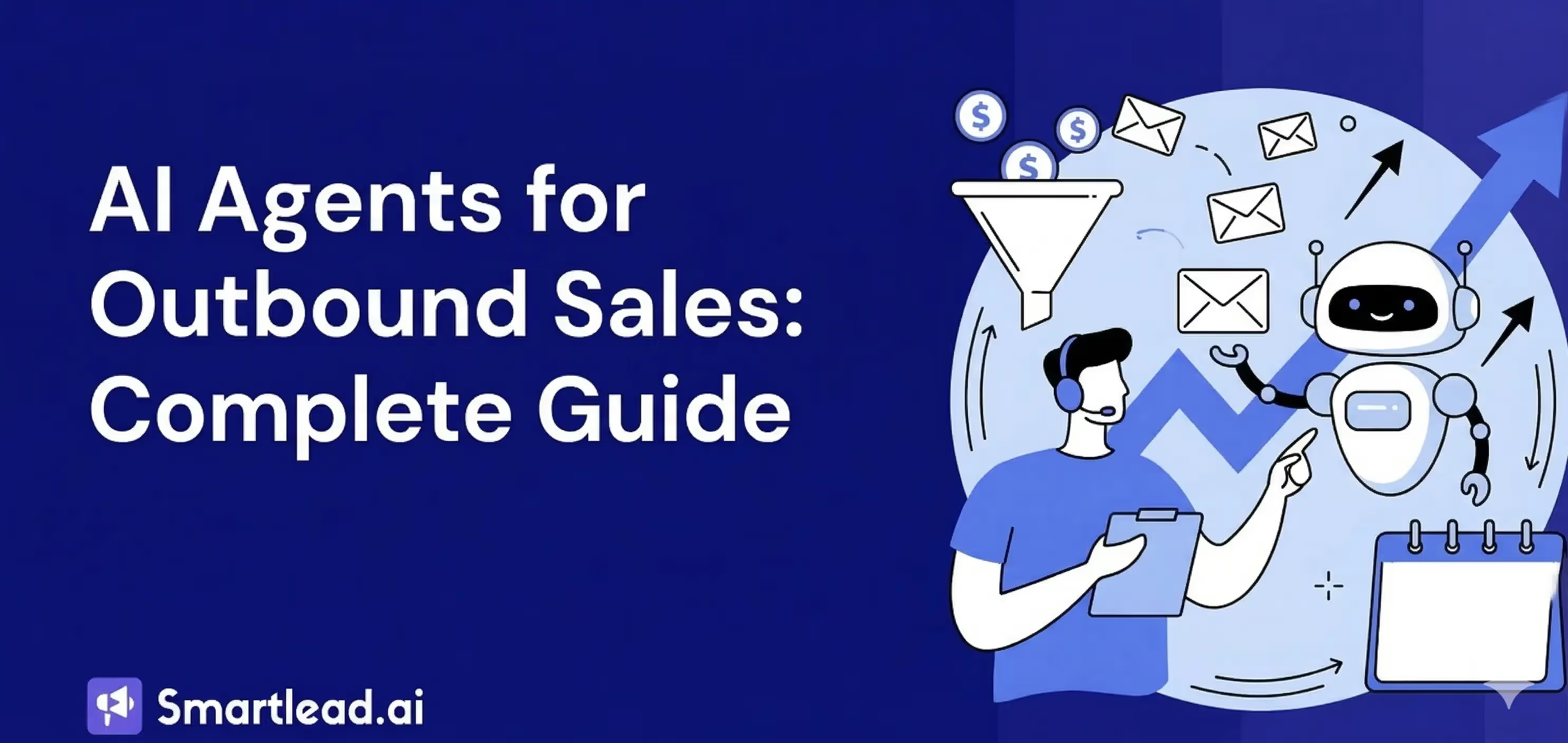
We build AI sales agents. We also operate the deliverability infrastructure that most of the other AI sales agents on this list run their email through. So when we say we've watched these tools succeed and fail at the wire level, we mean it literally: we see which AI agents' emails land in inboxes, which ones land in spam, and which ones get their customers' domains blacklisted within 30 days of launch. That's the lens this comparison runs on.
The AI SDR category is genuinely useful, genuinely overhyped, and genuinely full of vendors selling demos as production systems. Here's an honest read.
An AI SDR is software that does the job of a sales development rep without (or with minimal) human involvement. It identifies target accounts, builds prospect lists, drafts personalized outreach, sends sequences, monitors replies, and books meetings on the calendar. The pitch is one persistent agent (often given a human-sounding name like Ava, Alice, Jaz) doing the work of an entire SDR team for a fraction of the cost.
Whether that pitch holds up is the question this article exists to answer.
The term "ai sdr" is interchangeable with "ai sales agent," "autonomous sales agent," "ai sdr agent," and "ai sales assistant" depending on who's selling. The distinctions matter less than what the tool actually does. For this comparison, an AI SDR is any tool that attempts to handle the prospect-to-meeting workflow with the AI doing significantly more than just drafting copy.
That's the strict definition. In practice, the category overlaps with two adjacent ones: AI assistants (which augment a human SDR rather than replace them) and AI prospecting tools (which handle data and enrichment but not sending). I'll cover all three, because most buyer queries treat them as one bucket, and most stacks end up using a mix.
Three categories, three jobs.
AI SDRs are autonomous. They aim for zero-touch operation. You set up the ICP, the messaging guardrails, the calendar, and the agent runs the rest. Examples: Artisan AI (Ava), 11x.ai (Alice), Jeeva, AiSDR, Regie. The promise is replacement of human SDR work. The reality is varying degrees of supervision required to keep quality from collapsing.
AI assistants sit alongside a human. They draft, suggest, summarize, route, and surface signals, but a human stays in the supervisor seat for content and timing decisions. Examples: Outreach Smart Email Assist, Salesloft Rhythm, Smartlead's own SmartAssistant (an in-app diagnostic and navigation copilot, launched April 21, 2026, to all users). The promise is to amplify a rep's output, not replace them.
AI prospecting tools are the data and enrichment layer that feeds either of the above. Examples: Clay, Apollo, SmartProspect. They don't send. They surface, enrich, and structure prospect data so the agent or assistant on top has clean inputs to work with.
These categories overlap in marketing copy and separate cleanly in practice. A tool that promises everything tends to do nothing exceptionally. A tool that picks one job and goes deep is what shows up consistently in production stacks.
We sit at the intersection of three perspectives that no single AI SDR vendor has all three of, and that's what makes this article worth writing.
Builder. We ship SmartAgents, Smartlead's autonomous AI agent layer for outbound. We know the product problems involved at the architectural level. We've also shipped SmartAssistant, the in-app copilot that handles 28 diagnostic query types and 47 navigation actions across the platform (rolled out April 21, 2026, to every Smartlead user per the release notes). Builder credentials are real.
Operator. Hundreds of competing AI agents send their cold emails through Smartlead's deliverability infrastructure to their customers' inboxes. We see at the wire level which agents get blacklisted, which generate replies, which trip spam filters, and which break their customers' sender reputation inside 30 days. Vendors don't have this lens on each other. We do.
Honest comparator. We hold SmartAgents to the same scrutiny as Artisan or 11x. Where SmartAgents loses, the article says so. If you're running outbound at scale, Smartlead perfectly fits in your stack but if you are a soloprenur just starting outbound you should weigh your options.
What this article is not: a synthetic benchmark with fake reply-rate numbers. Reply rates depend on too many variables (sender reputation, list quality, vertical, copy, timing, ICP fit) for a single comparison number to mean anything. Where I cite specifics, they come from each vendor's published data, third-party reviews on G2, customer conversations, or Hunter.io and Kyle Poyar's published research.
| Tool | Best for | Starting price | Free trial | Sender model |
|---|---|---|---|---|
| Artisan AI (Ava) | Full-stack AI BDR with persona | ~$1,200/mo (per published) | Demo only | BYO infra |
| 11x.ai (Alice) | Autonomous SDR at scale | ~$1,500–$3,000/mo | Demo only | BYO infra |
| AiSDR | Cold email + reply automation | ~$750/mo | Demo only | BYO infra |
| Jeeva.ai | Outbound AI agent (mid-market) | Contact sales | Demo only | BYO infra |
| Regie.ai (RegieOne) | Sales engagement + AI agent | Contact sales | Demo only | BYO infra |
| Bardeen AI | Workflow + signal automation | $20/user/mo | Free tier | Tool-orchestrator |
| Outreach Smart Email Assist | Enterprise AI assist (not full agent) | ~$130/seat/mo | Demo only | BYO infra |
| Salesforce Agentforce | CRM-native AI agent | ~$2/conversation + Salesforce | Demo only | BYO infra |
| Clay (orchestration) | Enrichment + AI signal layer | $149/mo Starter | Free tier | Not a sender |
| Personize.ai | HubSpot-native AI SDR | ~$300/mo | Demo only | BYO infra |
| Smartlead SmartAgents | AI agents on dedicated deliverability infra | From $39/mo (Smartlead plan) | 14 days, no card | Own infra (SmartInfra) |
A note on database size and pricing: numbers above are self-reported by each vendor, current as of April 2026. Verify on each vendor's pricing page before committing. The "sender model" column is the one most buyers overlook: every AI SDR on this list except SmartAgents requires you to bring your own sending infrastructure (BYO). That choice is where most AI SDR campaigns quietly fail at scale, and we'll come back to it.
Best for: Agencies and enterprises running outbound at scale who want AI agent capabilities WITH the deliverability infrastructure underneath.
Disclosure: this is our product. I'm not going to pretend that's not a conflict.
SmartAgents is Smartlead's autonomous AI agent layer. It handles signal-driven prospecting (using SmartProspect's 300M+ verified profiles at flat-fee data pricing), sequence optimization, and reply management. The framing we use internally: AI for the repetitive analytical work, humans for the strategic decisions that close revenue.
The structural difference between SmartAgents and every other AI SDR on this list shows up in the "sender model" column of the comparison table. SmartAgents runs on Smartlead's Privatised SmartInfra, dedicated sending reputation that isn't pooled with thousands of other senders. Every other agent on this list requires you to bring your own sending infrastructure, which is fine until volume scales and you hit the shared-pool poisoning that breaks campaigns. That's not a hypothetical: I had one customer running 30k emails a month on shared infrastructure, watch reply rates fall from 6% to under 2% over six weeks with no copy changes. We migrated them to dedicated and they recovered in two weeks.
Smartlead also has SmartAssistant, that works as an in-app AI copilot for diagnostics, navigation, and support (28 query types, 47 actions).
Best for: mid-market and enterprise teams that want a branded AI BDR persona ("Ava") and full-stack autonomy.
Artisan is the highest-profile AI SDR in the category. Heavy fundraising, aggressive marketing, and a clear positioning as the "AI BDR replacement" play. The Ava persona is genuinely useful as a workflow framing: she prospects, drafts, sends, replies, and books meetings under one identity that customers can mentally model.
The product itself is solid for buyers who want a single-vendor handoff. Where it gets complicated: Artisan, like every full-autonomy AI SDR on this list, depends on you bringing your own deliverability infrastructure. Their generated emails go through whatever sender you point them at. We see customers running Artisan over Gmail-direct or shared sending pools hit deliverability cliffs around 60 to 90 days in.
One reason NOT to use: if you're not committing to a $50k+ annual contract, the value math gets hard against simpler hybrid stacks. Artisan is built for the buyer who wants to own one AI BDR rather than wire together multiple tools.
Best for: YC-flavored startups and growth-stage SaaS that want maximum autonomy with minimum implementation overhead.
11x is the most-discussed AI SDR in tech-Twitter and YC circles. Alice is their flagship outbound agent. The product positioning leans hard on "replace your SDR team" claims, and 11x has been more aggressive than most about marketing autonomy as the differentiator.
In production, the strength is speed of standup and the breadth of the data layer. The weakness is the same one every full-autonomy agent shares: quality control drops as volume scales, and the emails Alice generates at 1,000+ per day still trip the templated-AI detector that experienced buyers have developed. Hunter.io's 2026 State of Cold Email report found a meaningful share of decision-makers actively filtering content that reads as AI-generated.
One reason NOT to use: the marketing leans into autonomy claims that don't hold up under brand-sensitive outreach. If you're in a vertical where messaging mistakes carry real reputational cost, the supervisor-required hybrid model is a safer call.
Best for: SMB and mid-market teams that want autonomous cold-email-only outreach with built-in reply handling.
AiSDR runs a focused cold email + reply automation play. They've built strong content marketing around their own category, which is part of why they consistently show up in SERPs for "ai sdr" terms. The product's narrowest version is essentially: feed it a list, define the offer, let it draft and send and reply without further input.
Reply automation is the differentiator. Most AI SDRs handle the outbound side and dump replies into a generic inbox. AiSDR's agent stays in conversation, handling objections and scheduling without a human handoff for routine cases. That's genuinely useful when your reply volume scales past what a human can triage daily.
One reason NOT to use: quality of the AI-handled replies varies by vertical. In technical or enterprise sales conversations, the agent's responses can read as evasive when they hit something outside their training distribution. Worth piloting before committing.
Best for: mid-market teams that want a full-funnel AI SDR with a more polished UX than the YC-era cohort.
Jeeva is a newer entrant rising in mindshare, with a focus on the broader outbound funnel rather than just the cold email step. Their pitch is closer to "AI BDR ops" than "autonomous email tool," which is a useful framing for buyers who want the agent to think about pipeline shape rather than just message volume.
The product is competent on the basics. What's harder to verify without a paid pilot is how well their proprietary signal layer compares to Clay-based stacks for the same job, since Jeeva is largely a black box on the data side.
One reason NOT to use: newer than Artisan or 11x, less category mindshare, and the data layer is less transparent than running Clay on top of a sending infrastructure you can audit.
Best for: mid-market teams that already use a sales engagement platform and want AI agent capabilities bolted into the same workflow.
Regie has been in the sales engagement category longer than most of the AI-SDR-first entrants. RegieOne is their consolidated platform, combining sequencing, content generation, AI personalization, and increasingly agent-style autonomy on top of an established product. That history is the strength: less risk of the platform disappearing in a category shakeout.
The trade-off is that the AI layer reads as built on top of an older sales engagement architecture rather than designed agent-first. For teams already running Regie or coming from Outreach/Salesloft, the migration path is short. For teams starting fresh, the AI-native entrants tend to feel more cohesive.
One reason NOT to use: if you want a clean AI-first agent without legacy sales engagement complexity, Artisan or 11x will feel more cohesive.
Best for: technically inclined teams that want to wire AI into the cracks of their existing GTM stack rather than buy a turnkey AI SDR.
Bardeen is a different shape of tool than the rest. It's not a self-contained AI SDR. It's a workflow automation layer with AI playbooks that can be assembled into something resembling an SDR pipeline if you have the technical instinct to build it. Think Zapier with a brain, oriented toward sales workflows.
For RevOps and GTM Engineer types, Bardeen is genuinely powerful. You can build signal-detection flows, enrichment chains, and outreach triggers that no turnkey AI SDR will customize for you. The cost is build time. Bardeen rewards operators who like spreadsheets and APIs.
One reason NOT to use: if you don't have an ops-minded person who enjoys building workflows, Bardeen sits unused. It's a power tool, not a replacement for product thinking.
Best for: enterprise sales teams already on Outreach who want AI augmentation without changing platforms.
Outreach is the enterprise default for sales engagement at 50+ SDR organizations. Smart Email Assist is their AI layer: draft suggestions, sequence optimization, reply categorization, call analysis through Kaia. It's an AI assistant rather than an autonomous agent, which is the right call for the regulated, brand-sensitive enterprise environments Outreach customers tend to operate in.
Pricing typically lands around $130/seat/month with annual contracts and 8 to 12 weeks of implementation work before a team is fully productive. That's the price of getting the integration story right with Salesforce and the rest of the enterprise stack.
One reason NOT to use: overkill for sub-50-SDR teams, and the AI capabilities are deliberately conservative compared to the autonomous category. If you want zero-touch, this isn't the tier.
Best for: Salesforce-anchored enterprises that want AI agent capabilities inside the system of record.
Agentforce is Salesforce's bet on the agent category, built natively into the CRM. The advantage is data access: the agent runs on the full account history, contact data, and activity that already lives in Salesforce. That's structurally different from any third-party AI SDR that has to import or sync data to operate.
Pricing is per-conversation (commonly cited around $2 per conversation, plus the Salesforce contract underneath), which makes the unit economics meaningfully different from seat-based or flat-fee competitors. For high-volume enterprise outbound, that math compounds fast.
One reason NOT to use: if you're not already on Salesforce, the platform tax stops being justifiable for the AI agent capability alone. And the pricing model rewards low-volume, high-value motions, not high-velocity outbound.
Best for: teams running signal-driven outbound with a data-minded operator who can build workflows.
Clay isn't a sender, isn't an autonomous agent, and doesn't pretend to be either. It's the enrichment and signal layer most production "AI SDR stacks" actually run on. Point Clay at a list, it pulls data from 100+ providers in waterfall sequence, runs AI prompts on the enriched record, and outputs personalized message variants at the row level.
A common production pattern in our customer pipelines: Clay enriches and writes message variants, an AI SDR or hybrid agent handles drafting and sequencing, and Smartlead handles the sending and deliverability. That combination is what most "AI SDR" deployments actually look like under the hood, even when they're sold as a single agent.
One reason NOT to use: Clay rewards teams with at least one data-minded operator. Without that person, a Clay seat sits unused. I've watched teams buy Clay in Q1 and still not have a real campaign live by Q3, not because the tool didn't work but because nobody had the data instincts to drive it. Their G2 rating sits at 4.7/5 across 193 reviews.
Best for: HubSpot-anchored teams that want an AI SDR layer inside their existing CRM.
Personize is the HubSpot-native counterpart to Salesforce Agentforce, sitting inside the HubSpot ecosystem and generating personalized outreach from CRM data. The pitch is similar: data access without integration overhead. The reality is similar too: the value proposition compounds for buyers already deeply on HubSpot, and stops making sense for anyone else.
For HubSpot-anchored mid-market teams running outbound off the same record system as their marketing, Personize is the cleanest agent-style addition.
One reason NOT to use: if you're not on HubSpot, this isn't the right entry point. The CRM-native advantage evaporates.
The category isn't fake. It's also not the category most vendors sell. Three conditions where AI SDRs deliver, and three where they fail.
They work when: the buyer journey doesn't require nuance (commodity SaaS, transactional offers, straightforward ICP); the volume justifies the autonomy premium ($35K-$65K all-in cost only makes sense when you're replacing 1-2 full SDR salaries plus tools); and the deliverability infrastructure underneath is dedicated rather than shared. Strip any of those three, and the math breaks.
They fail when: the vertical is regulated or brand-sensitive (financial services, healthcare, enterprise security), where one off-key automated email creates real reputational cost; ACV is too low to absorb the fully-loaded cost of running an AI SDR effectively (under $10k ACV, hybrid models almost always win on unit economics); or the sender infrastructure is shared with thousands of other senders, where one customer poisoning the pool drags everyone's reply rates down with them.
The pattern across thousands of campaigns we observe at the infrastructure layer: AI SDRs sending from poorly warmed mailboxes on shared IPs land in spam at 3 to 4x the baseline rate of properly warmed dedicated setups. The agent is fine. The pipes underneath aren't, and the agent gets blamed.
What top-performing teams actually run, per Kyle Poyar's signal-based outbound research and our customer data: signal-based prospecting (leadership changes, funding rounds, hiring surges, tech adoption), AI-assisted personalization at the draft layer with human review, dedicated sending infrastructure, and 4-6 week warmup before pointing any AI at fresh sender accounts. That stack hits 15 to 25% reply rates on signal-targeted campaigns. The fully autonomous "AI SDR replacing your team" pitch hits 1 to 3% at production scale.
A short tangent worth making, because it explains why the comparison table puts so much weight on the "sender model" column.
Most AI SDR vendors don't operate the deliverability layer that their generated emails travel through. They generate, then hand off to whatever sender the customer has wired up: Gmail-direct, a shared cold email tool, or a marketing platform. That handoff is where most AI SDR campaigns quietly fail.
We built SmartAgents on top of Privatised SmartInfra (dedicated IPs and sending reputation), unlimited email warmup on every plan, and a unified master inbox for reply management across email, LinkedIn, and other channels. The agent doesn't run separately from the infrastructure. It runs as one system.
The reason: we watch what happens to AI agents that don't have this. Hundreds of competing agents send their generated emails through Smartlead's infrastructure to their customers' inboxes (their customers chose Smartlead for the deliverability layer, then bolted on an AI agent on top). We see the failure modes. We built SmartAgents to remove them at the system level, not paper over them with a better prompt.
If you want to test your current sender infrastructure before adding any AI on top, run an email deliverability test. If your bounce rate is above 2% or your placement isn't consistently in the primary inbox, no amount of AI cleverness will fix that. Fix the layer underneath first.
14 days, no card required. Run AI agent campaigns on Privatized SmartInfra with unlimited email warmup and SmartProspect data included.
Start free trial →After watching customers pick between these tools every week, the decision tree is fairly clean.
You're a Series A or B SaaS company chasing zero-touch outbound autonomy. Artisan or 11x. Both deliver on the autonomy promise inside the verticals where it works (commodity SaaS, mid-market ACV, low-stakes messaging). Pair with dedicated sending infrastructure or expect deliverability decay around 60 to 90 days.
You're a HubSpot-anchored mid-market team. Personize.ai for CRM-native, or Clay if you have a data-minded operator. Personize feels lower friction; Clay rewards builders.
You're a Salesforce-anchored enterprise. Salesforce Agentforce for CRM-native, or Outreach Smart Email Assist if you're already on Outreach. Both are conservative-by-design, which fits the enterprise risk profile.
You're a technical RevOps team building a custom stack. Clay for enrichment and signal layer, plus a sender of your choice. Bardeen, if you want broader workflow automation across the GTM stack. This is the highest-skill ceiling but produces the highest-performing setups in our customer base.
You're an agency or enterprise running outbound at scale. Smartlead SmartAgents is the right next layer. The agent runs on the deliverability infrastructure you're already on, which removes the failure mode that kills most AI SDR deployments at scale.
You're a non-technical solopreneur. None of these. Run a cold email tool with proven templates and good deliverability. The AI SDR category isn't built for your scale.
The patterns of failure in this category are clearer than the patterns of success. Three mistakes I see repeatedly across the AI agent stacks running through our infrastructure.
Don't ship AI-generated emails without a human review pass. AI is competent at writing cold email. Competent isn't enough when your prospect gets 40 cold emails a week. The replies come from emails that have a human edge: a specific observation about the company, a reference that doesn't read as scraped from a database. The hybrid model exists because that human edge is the difference between a 3% reply rate and a 12% reply rate.
Don't run AI agents on shared sending infrastructure. This is the failure mode I see most often at the infrastructure layer. The agent generates clean copy, the copy goes through a shared IP pool, the pool gets poisoned by another sender's bad behavior, and reply rates collapse for reasons unrelated to the agent. If you're paying for an AI SDR, pay for dedicated infrastructure underneath. Anything less and you're gambling reply rates on strangers.
Don't skip warmup because the AI is in a hurry. Sender reputation is a 4 to 6 week investment, and AI agents don't change that physics. A new domain pointed at an autonomous agent without warmup hits spam folders regardless of how good the prompt is. Run warmup before warming up your campaign volume. Skip it and your reply rates will be worse than your old workflow.
An AI SDR is software that handles sales development rep work (prospecting, drafting, sequencing, replying, booking) with AI doing significantly more than just generating copy. The category overlaps with "ai sales agent," "autonomous sales agent," and "ai sales assistant" depending on how vendors market the same capabilities. In production, the most reliable setups are hybrid: AI for research and drafts, humans for final review and strategic calls.
Depends on volume and vertical. The fully-loaded cost of running a fully autonomous AI SDR (data, infrastructure, warmup, oversight) lands closer to $35K to $65K per year per agent than the $500/month most vendors advertise. That math works for teams replacing 1 to 2 SDRs at scale in commodity SaaS verticals. It doesn't work for SMB-scale outbound or regulated verticals where messaging mistakes carry reputational cost.
An AI SDR aims for autonomous operation (zero touch, the agent runs prospecting through booking without human input). An AI sales assistant augments a human SDR (drafts, suggestions, summaries, reply categorization, with the human in the supervisor seat). Outreach Smart Email Assist and Smartlead's SmartAssistant are assistants. Artisan, 11x, AiSDR, and Smartlead SmartAgents are agents.
Not yet, in 2026. Fully autonomous agents generate volume but consistently underperform hybrid AI plus human models on reply rates and quality. The best in-production setups use AI for the analytical and repetitive work and keep humans on strategic decisions and high-value conversations. Anyone selling "AI SDRs that fully replace your team in 2026" is showing you a demo and calling it production. Maybe in 2027. Not this year.
Industry data points to 1 to 3% for fully autonomous AI SDR campaigns at production scale, 8 to 15% for hybrid AI plus human approaches, and 15 to 25% for signal-based outbound on top of hybrid AI in reported industry data. Hunter.io's 2026 State of Cold Email report puts the average reply rate at 4.5% across 31 million emails. If your AI SDR is hitting under 5% replies, the agent isn't the problem; the data, signals, or sender infrastructure underneath is.
Pure-play autonomous AI SDRs (Artisan, 11x, AiSDR, Jeeva) range from $750/month to $5,000+/month per agent on the published pricing, with fully-loaded costs (including data, infrastructure, warmup, oversight) reaching $35K-$65K/year. Enterprise-tier AI assistants (Outreach, Salesloft, Salesforce Agentforce) typically run $125-$130/seat/month plus per-conversation pricing. Smartlead SmartAgents capabilities are included with Smartlead plans starting at $39/month, with SmartProspect at a flat $59/month for the data layer.
Yes. SmartAgents is Smartlead's autonomous AI agent layer, running on top of dedicated Privatised SmartInfra, SmartProspect data, and the unified master inbox for reply management. Separately, Smartlead launched SmartAssistant on April 21, 2026, an in-app AI copilot for diagnostics and navigation across the platform. Different product, different category.
For technical teams with at least one data-minded operator, the Clay + AI-personalization + dedicated-sender hybrid consistently outperforms turnkey AI SDRs on reply rates and economics. For non-technical teams, a turnkey AI SDR is the lower-friction starting point even if it's less performant per dollar.
If your reply rates are decent but your AI SDR's emails keep landing in Promotions or Spam, the issue isn't the agent. It's the infrastructure underneath. Smartlead's free trial gives you 14 days on Privatised SmartInfra with unlimited warmup and SmartProspect data included. Run side-by-side tests against your current setup.
Try Smartlead free →Book a Demo →
Founder, StackOptimise
Smartlead's combination of automation, unlimited inboxes, and easy campaign management has completely transformed how we run cold email campaigns.
.jpg)
Founder, Cold Email Hackers

We have about 15 companies and we use Smartlead for all of them.

Founder, DutchSave Media

One of the things I love about using Smartlead is the deliverability feature. If they landed in the bounce or spam folders, we could resolve this quickly.

Co-Founder, Growth Today

I want to continue to use Smartlead to make operations more seamless - the plan is to bring more clients here and build more SOPs.

Founder, FueltoFly

Smartlead listens to the agencies and customers and builds according to what people want, that has really made things easier for us.

Founder, OutboundSync

We build an infrastructure product, and OutboundSync communicates with Smartlead itself. I love the webhook and API. They're really well done and keep getting better.

Founder, Axoleads

With SmartDelivery, you can put all of that in the hands of the tool. It ensures your emails land in inboxes, and by running a simple test, you can see if you're hitting the mark.

Founder, Claygen
Deliverability is the cornerstone of cold email outreach. You could have the best email copy in the world, but if no one is seeing it, it's useless. I really love the feature where you can actually give client accesses to your clients.

Co-Founder, Cymate

I do not want to switch to another software. Pick a solution you trust, stick with it, and keep refining your copy.

CMO, Avalanche Capital

Managing large volumes of emails through multiple inboxes used to be a logistical nightmare. With Smartlead, the process is seamless. We book thousands of discovery calls through cold emails. These campaigns are generating leads at a scale we never thought possible.

Founder, Growth Engine X

We came for the unlimited inboxes, and we stayed for the API. 1.5M cold emails/month, 7,767+ inboxes managed.

Head of Community & Ecosystem, TxtCart

You cannot replace having 10,000 touches with potential clients. When you have that much distribution and reach, you really start to see incredible results. The simplicity of Smartlead made all the difference. It doesn't require you to be a technical wizard.

Founder, Hyperke

Smartlead has been a game-changer for us. It increased our appointment volume, improved ease of use, and offered valuable features. 80% increase in appointments/month, peak of 276 appointments in a single month.

Founder, Kinetyca

Smartlead has been our cold email backbone from day one. The platform evolves constantly, keeping pace with how deliverability and personalization need to work today. 21% overall reply rate, $175K in 4 months for multiple B2B clients.

Founder, Reachflow

Smartlead is centered around deliverability and constantly evolving. Their API is not like any other platform. Smartlead covers all our needs. The focus on core features like deliverability and API integration is unmatched.

CEO, Halfwarm

Our approach to crafting conversational emails led to reply rates that many of my peers thought were unattainable.

Co-Founder, letstrike
We've grown on zero capital, zero marketing, purely cold emailing - and that's the story we love to tell. The best approach is no approach if you can't handle domain meltdown. The second best is something like Smartlead that's built from the ground up for deliverability at scale.

Founder, Fenixtal

Smartlead's white-labeling and automation let us punch above our weight. The 12M euros sales potential? That's what happens when you combine human creativity with Smartlead's precision.

Co-Founder, Digital Creativs

Nine out of 10. Ninety percent of our clients are on Smartlead unless they come in with an existing setup. That's the default.

Co-Founder, BuildingReach

At the end of the day, you have to take a bet on one tool or another. It was a no-brainer taking that bet on Smartlead. We had to even turn down the volume of our marketing campaigns - Smartlead was capable of driving more volume than our sales team was able to fulfill.

Founder & MD, Prospectiv

Since starting the business in January of this year, we've already generated $200K in sales exclusively from cold email. Smartlead has been central to our operations and has exceeded our expectations.

Founder, Growthlynk

There's so much stuff built on top of it. I would be dead if I had to rebuild it with another tool. I can manage hundreds of senders easily. I can send hundreds of thousands of emails.

Founder, Corebits

The platform's HubSpot integration, real-time Slack updates, and advanced campaign customization have been game changers for our business and our clients'.

Founder, Apex Ascension

From day one, we've never used anything else.