


Sign up now and get 50% off on your first month on any plan

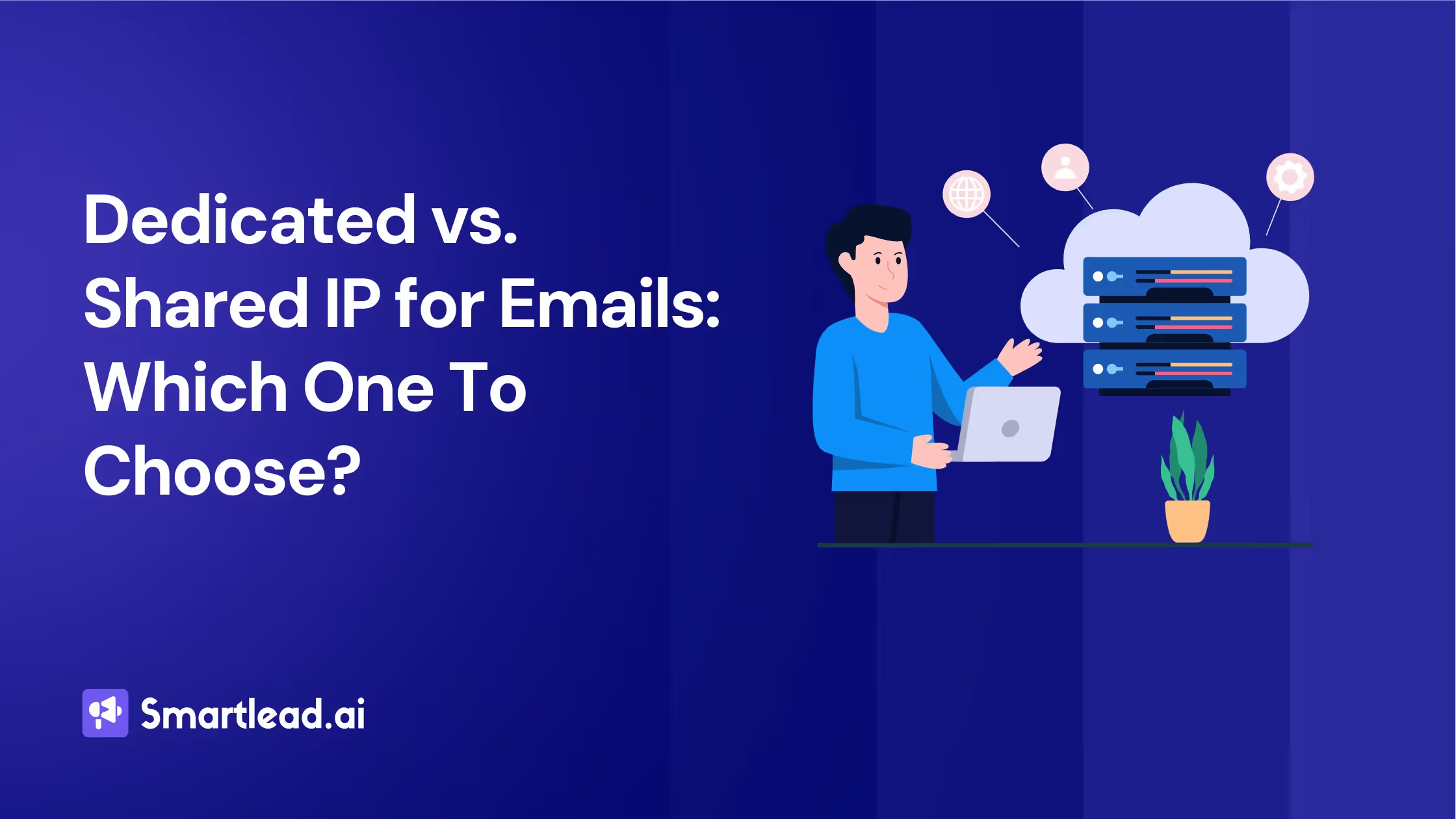
When you send an email, your message doesn't just rely on its content or design to make it to the recipient's inbox. A significant factor working behind the scenes is your IP address—the digital identifier that can significantly impact your email deliverability.
Quick Answer: A shared IP address is used by multiple senders and is less expensive, while a dedicated IP address is exclusive to one sender and provides complete reputation control. Choose shared IPs for under 50K emails monthly, dedicated IPs for 100K+ emails.
Think of your IP address as the return address on a letter. Email providers like Gmail and Outlook use this digital identifier to determine whether your message should be trusted or filtered to spam.
Even a perfectly written email can end up flagged or rejected outright if the IP reputation is poor. This is why the infrastructure choice you make — shared IP address or dedicated IP — is foundational to your entire outbound strategy.
There are two primary options: shared IP addresses, used by multiple senders simultaneously, and dedicated IP addresses, used exclusively by one sender. Whether you're running cold email campaigns at scale or just getting started, choosing the right SMTP server infrastructure for cold email is one of the highest-leverage decisions you can make.
A shared IP address is an IP address that multiple users share to send their emails. Most email service providers default to shared IPs for their standard plans.
Here is how it works: your emails, along with those from other businesses, are sent through the same IP address managed by the ESP. The IP's reputation is collectively shaped by all senders using it. If most users follow good practices — sending quality emails to verified contacts — the shared IP can maintain a solid sender reputation.
The risk: if other senders on the same pool engage in spammy behavior, your deliverability takes a hit even if your own practices are clean. That is the defining trade-off with any shared IP address.
When shared IPs make sense:
What G2 users say about shared IP performance:
"For our volume — around 20,000 emails per month — the shared infrastructure worked perfectly. Deliverability was solid from day one without any warm-up overhead." — G2 reviewer, SMB segment
"The shared sending pool meant we could hit the ground running. No ramp period, no DNS headaches. That matters a lot when you're a team of two." — G2 reviewer, marketing agency
A dedicated IP address is assigned exclusively to a single sender. Your emails are the only ones sent from that IP, giving you complete control over your IP reputation — and complete responsibility for it.
For cold email marketing agencies sending more than 150,000 emails per month, or e-commerce platforms sending transactional email at scale, dedicated IPs are not optional — they are table stakes. The exclusivity ensures that no other sender's behavior can undermine your deliverability.
The trade-off: dedicated IPs require a warm-up period of 4 to 8 weeks, ongoing monitoring, and consistent sending volume to maintain a healthy reputation. Buying a dedicated IP without proper management is like acquiring premium sending infrastructure and then burning your domain anyway.
When dedicated IPs make sense:
What G2 users say about dedicated IP performance:
"Once we completed the warm-up and got our dedicated IP established, our inbox placement improved dramatically. Worth every penny at our volume." — G2 reviewer, B2B SaaS
"We moved to a dedicated IP after hitting 200K monthly sends. The improvement in reply rates was immediate and measurable." — G2 reviewer, outbound agency
"The control over your own reputation is the real value. With a shared IP, you're always at the mercy of other senders." — G2 reviewer, demand generation
Think of your emails swimming in the same pool as hundreds of other businesses. If everyone follows good practices, the shared pool performs well. If one bad actor spams from the same IP range, every sender on it pays the price.
Benefits:
Drawbacks:
With a dedicated IP, every email sent from that address reflects only your sending behavior. That cuts both ways: excellent practices build a strong IP reputation, and sloppy practices degrade it — fast.
Benefits:
Drawbacks:
Your IP type is just one layer of your email sending infrastructure. Whether you are operating on a shared IP or a dedicated one, the infrastructure beneath it determines your ceiling.
SmartSenders and SmartInfra within Smartlead are purpose-built for outbound at scale — giving senders the infrastructure foundation that both shared and dedicated IP strategies depend on. Pair that with proper email authentication (SPF, DKIM, DMARC) and you have the structural baseline every serious sender needs regardless of IP type.
The email warm-up process also sits at the infrastructure layer. Unlimited automated warm-ups — available through Smartlead's warmup pool — are especially critical for anyone launching a dedicated IP or a fresh mailbox, and they run silently in the background without requiring manual intervention.
For agencies managing dozens of client accounts, the Smartlead Master Inbox centralizes replies across all sending accounts and IPs — a practical necessity when you are managing scale across both shared and dedicated infrastructure simultaneously.
IP reputation is the score that mailbox providers assign to your sending IP based on observed behavior. It is calculated using signals like spam complaint rates, bounce rates, engagement, and blacklist history.
Poor IP reputation is often the hidden reason emails land in spam — not the copy, not the subject line, not the sequence structure. Understanding and actively managing it is one of the most important technical skills in outbound.
Key IP reputation signals to monitor:
Use the Smartlead email deliverability test to audit your current sending health across all active accounts. It surfaces reputation issues before they become deliverability crises.
For a comprehensive breakdown of what moves the needle, the email deliverability improvement guide covers the full picture — from DNS hygiene to list quality to behavioral signals.
Each major provider evaluates IP reputation differently.
Gmail can differentiate individual senders on a shared IP by examining DKIM domain alignment. This means domain reputation often matters more than IP reputation in Gmail's filtering decisions.
Dedicated IPs still provide better monitoring through Google Postmaster Tools, but even on a shared IP, your domain-level practices drive your Gmail deliverability.
Gmail's rule: Keep spam complaint rates below 0.3% regardless of IP type. Google and Yahoo both announced in February 2024 that domains hitting 0.3% or higher face automatic delivery problems — a policy that applies to both shared and dedicated IP users.
Outlook's filtering assesses both the IP and the sending domain. On a shared IP, poor behavior from other senders in the pool can affect the entire range.
Dedicated IP users gain access to Microsoft's Smart Network Data Services (SNDS), which provides detailed reputation monitoring including subscriber complaints and spam trap data — visibility that shared IP users simply do not have.
Yahoo employs the strictest approach to IP-level filtering among the major providers. Entire shared IP ranges can be permanently blocked if spam complaint rates exceed 0.3% — no appeals, no second chances.
Dedicated IP users can enroll in Yahoo's Feedback Loop program for direct spam complaint monitoring and faster remediation.
When you are setting up an SMTP server for cold email, the shared vs dedicated question intersects with deliverability in ways that go beyond basic reputation management.
On a shared SMTP infrastructure, you benefit from pooled reputation when it is healthy, but you lack visibility into what other senders are doing to that pool. On a dedicated SMTP server, every deliverability signal traces back to your own behavior — better for diagnosis, but higher-stakes.
For high-volume cold email, the recommended architecture uses dedicated IPs through purpose-built infrastructure like SmartServers — not a repurposed transactional ESP or a generic shared SMTP relay.
SmartServers is Smartlead's dedicated IP infrastructure layer. It gives outbound agencies and high-volume senders dedicated IP addresses with full reputation isolation, advanced monitoring via SQL-based analytics, and direct API integration with Smartlead campaigns. Built specifically for businesses where email deliverability is a revenue-critical function.
These are not edge cases. These are repeatable outcomes from senders who built their infrastructure correctly:
Jaime de Wenetz, Founder — Unlock Management (Madrid-based GTM agency)"50% of the business is made in Smartlead. Everyone doing outbound is using Smartlead. Emails do not go to spam, so why should we change it?"Results: 25% reply rate, 18–20% positive reply rate, NPS 10/10Read the Unlock Management case study →
Alexander Yevtushenko, Founder — AvoraGrowth"You can upload as many contacts as you want and it is unlimited and you do not have to pay more. That is probably the best thing you have added to Smartlead recently."Results: $2M+ pipeline in Q3–Q4 2025, 30% positive reply rate, 20+ active clientsRead the AvoraGrowth case study →
Vladislav Molchanov, CEO — The Pipeline Inc."Smartlead improved our deliverability and gave us the tools to turn cold emails into conversations."Results: 56% positive reply rate from 1,400 contacts, 78% open rate, $15K revenue from a single targeted campaignRead the case study →
Ty Shane, Founder — 10x AI Advisors"SmartDelivery has been the 100% reason we were able to achieve the numbers for our campaigns."Results: 21 booked calls from 69 replies in 72 hours, 33–60% positive reply ratesRead the case study →
Practical examples where shared IP is the right call:Local service businesses with under 10,000 subscribers. B2B consultants running targeted outreach to a curated list. Non-profits managing donor communication at modest volume.
Practical examples where dedicated IP is the right call:Marketing agencies sending 500K+ cold emails monthly. E-commerce platforms processing millions of order confirmations. SaaS companies with critical onboarding and lifecycle sequences.
Jumping from a shared IP to a dedicated one without warming up is one of the most common deliverability mistakes high-volume senders make. The warm-up process signals to mailbox providers that you are a legitimate, consistent sender — not a sudden burst of unknown traffic.
Standard warm-up timeline:
During warm-up, prioritize high-engagement campaigns, monitor bounce rates closely (under 2% is the target), use authentication protocols from day one, and track reputation scores weekly.
Smartlead's automated email warm-up infrastructure handles this ramp in the background, removing the manual overhead from warm-up management entirely.
Consider this when email volume drops below 50K per month, budget constraints require infrastructure cost reduction, or technical management overhead becomes unsustainable.
Note: switching back means losing reputation control and potentially experiencing temporary deliverability fluctuations as your domain adjusts to the new sending environment.
If dedicated sending infrastructure is the right call for your volume and goals, SmartServers is the cleanest path to get there within the Smartlead ecosystem.
SmartServers provides dedicated IP addresses purpose-built for high-volume outbound, with:
For agencies and enterprise senders, this removes the single biggest deliverability risk that comes with shared infrastructure: other senders. Every metric you monitor, every deliverability signal you receive, reflects only your own behavior.
Learn more and get started at smartlead.ai/privatised-smartinfra.
Even the best dedicated IP is limited by list quality. IP reputation degrades quickly when you are sending to unverified contacts — high bounce rates and spam complaints are the fastest way to poison a freshly warmed IP.
SmartProspect's free verified leads solves the list quality problem upstream. Verified, accurate prospect data means your sending hits real inboxes — protecting both your IP reputation and your deliverability infrastructure over time.
At the furthest edge of the stack, SmartAgents operates as Smartlead's autonomous GTM execution layer — not just automating individual tasks, but running full outbound sequences with real-time adaptive logic. Infrastructure quality is the constraint that determines how far agentic outbound can scale. A well-managed dedicated IP is what allows SmartAgents to operate at volume without deliverability ceilings.
The shared IP vs dedicated IP debate is ultimately a volume and control question. At under 50K monthly sends, shared infrastructure is cost-effective, reliable, and requires minimal management overhead. At 100K+ sends — especially in agency and enterprise contexts — dedicated IPs give you the reputation control, monitoring access, and performance consistency that shared pools cannot guarantee.
Both options can deliver strong results when managed correctly. The most common failure mode is not choosing the wrong IP type — it is choosing the right one and managing it poorly.
The formula that holds across both: strong email content + proper IP and infrastructure strategy + consistent sending patterns + clean verified lists = inbox placement at scale.
Ready to build the infrastructure layer your outbound deserves? Explore Smartlead's pricing and see how SmartServers fits into your sending stack.

A shared IP address is used by multiple businesses simultaneously to send emails. The ESP manages the IP's reputation based on the collective sending behavior of all users.
Switch to a dedicated IP address when you consistently send 100,000+ emails monthly, need complete reputation control, or send mission-critical transactional emails.
Dedicated IP addresses typically cost an additional $30-300 per month, depending on your email service provider and plan level.
Yes, if other users on your shared IP address engage in poor sending practices, it can negatively impact your deliverability even if you follow email deliverability best practices.
Dedicated IP warm-up typically takes 4-8 weeks, gradually increasing from 50 emails daily to your full sending volume.
Yes, dedicated IP addresses require ongoing monitoring of reputation scores, bounce rates, spam complaints, and authentication protocols.
Yahoo is most aggressive about IP-level filtering, Outlook maintains a balanced IP/domain focus, while Gmail prioritizes domain reputation over IP reputation.
Join us to elevate your outreach!


Founder, StackOptimise
Smartlead's combination of automation, unlimited inboxes, and easy campaign management has completely transformed how we run cold email campaigns.
.jpg)
Founder, Cold Email Hackers

We have about 15 companies and we use Smartlead for all of them.

Founder, DutchSave Media

One of the things I love about using Smartlead is the deliverability feature. If they landed in the bounce or spam folders, we could resolve this quickly.

Co-Founder, Growth Today

I want to continue to use Smartlead to make operations more seamless - the plan is to bring more clients here and build more SOPs.

Founder, FueltoFly

Smartlead listens to the agencies and customers and builds according to what people want, that has really made things easier for us.

Founder, OutboundSync

We build an infrastructure product, and OutboundSync communicates with Smartlead itself. I love the webhook and API. They're really well done and keep getting better.

Founder, Axoleads

With SmartDelivery, you can put all of that in the hands of the tool. It ensures your emails land in inboxes, and by running a simple test, you can see if you're hitting the mark.

Founder, Claygen
Deliverability is the cornerstone of cold email outreach. You could have the best email copy in the world, but if no one is seeing it, it's useless. I really love the feature where you can actually give client accesses to your clients.

Co-Founder, Cymate

I do not want to switch to another software. Pick a solution you trust, stick with it, and keep refining your copy.

CMO, Avalanche Capital

Managing large volumes of emails through multiple inboxes used to be a logistical nightmare. With Smartlead, the process is seamless. We book thousands of discovery calls through cold emails. These campaigns are generating leads at a scale we never thought possible.

Founder, Growth Engine X

We came for the unlimited inboxes, and we stayed for the API. 1.5M cold emails/month, 7,767+ inboxes managed.

Head of Community & Ecosystem, TxtCart

You cannot replace having 10,000 touches with potential clients. When you have that much distribution and reach, you really start to see incredible results. The simplicity of Smartlead made all the difference. It doesn't require you to be a technical wizard.

Founder, Hyperke

Smartlead has been a game-changer for us. It increased our appointment volume, improved ease of use, and offered valuable features. 80% increase in appointments/month, peak of 276 appointments in a single month.

Founder, Kinetyca

Smartlead has been our cold email backbone from day one. The platform evolves constantly, keeping pace with how deliverability and personalization need to work today. 21% overall reply rate, $175K in 4 months for multiple B2B clients.

Founder, Reachflow

Smartlead is centered around deliverability and constantly evolving. Their API is not like any other platform. Smartlead covers all our needs. The focus on core features like deliverability and API integration is unmatched.

CEO, Halfwarm

Our approach to crafting conversational emails led to reply rates that many of my peers thought were unattainable.

Co-Founder, letstrike

We've grown on zero capital, zero marketing, purely cold emailing - and that's the story we love to tell. The best approach is no approach if you can't handle domain meltdown. The second best is something like Smartlead that's built from the ground up for deliverability at scale.

Founder, Fenixtal

Smartlead's white-labeling and automation let us punch above our weight. The 12M euros sales potential? That's what happens when you combine human creativity with Smartlead's precision.

Co-Founder, Digital Creativs

Nine out of 10. Ninety percent of our clients are on Smartlead unless they come in with an existing setup. That's the default.

Co-Founder, BuildingReach

At the end of the day, you have to take a bet on one tool or another. It was a no-brainer taking that bet on Smartlead. We had to even turn down the volume of our marketing campaigns - Smartlead was capable of driving more volume than our sales team was able to fulfill.

Founder & MD, Prospectiv

Since starting the business in January of this year, we've already generated $200K in sales exclusively from cold email. Smartlead has been central to our operations and has exceeded our expectations.

Founder, Growthlynk

There's so much stuff built on top of it. I would be dead if I had to rebuild it with another tool. I can manage hundreds of senders easily. I can send hundreds of thousands of emails.

Founder, Corebits

The platform's HubSpot integration, real-time Slack updates, and advanced campaign customization have been game changers for our business and our clients'.

Founder, Apex Ascension

From day one, we've never used anything else.