

Sign up now and get 50% off on your first month on any plan


If you've been running cold email at scale this year, you've probably noticed reply rates dropping even when nothing changed in your sequences. The cause is rarely your copy.
Inbox providers got stricter, and prospects learned to ignore unfamiliar sender names. The email that converted at 4% last year now converts at 1%.
Most teams trying to recover from this curve are turning to multi-channel outreach.
Multi-channel outreach is the practice of running a coordinated set of touches across email, LinkedIn, and phone, all aimed at the same prospect, instead of betting on a single channel to do all the work. Reply rates compared to single-channel cold email tend to be two to four times higher in most benchmarks, though the actual numbers depend on what you sell and to whom.
This piece walks through what's actually inside one of these sequences, the parts that tend to break, and a 14-day template that works for most B2B motions.
Here's the simplest way to describe it. You send a prospect a cold email on Monday morning, send them a LinkedIn connection request on Wednesday, leave a voicemail on Friday, and send a follow-up email the next Monday referencing the voicemail.
The prospect didn't reply to any of those touches individually, but on touch five they wrote back. That's multi-channel, more or less.
A coordinated set of touches across two or three different channels, running against the same prospect over the span of one to three weeks, with each touch supposed to build on the last rather than start from zero.
The thing it's often confused with is omnichannel marketing, which is something different (a brand showing up across paid ads, organic, email, and social to a broad audience). Multi-channel outreach is sales-side prospecting that targets specific people one at a time.
The audience and intent are different, which is why the playbook ends up different too, even though both of them use multiple channels.
The reason all this became necessary in the first place is that cold email alone stopped working for most teams over the past few years. Inbox providers tightened their filtering, spam scoring got more aggressive, and prospects learned to skip sender names they didn't recognize.
All of this happened gradually enough that some teams didn't notice their reply rates were dropping until the pipeline number got bad enough to investigate. Teams that kept booking meetings adapted by layering channels, which spread the load and gave them more chances to land on the right day for the right person.
The main argument for layering channels is the reply rate. Industry benchmarks suggest single-channel cold email sequences land somewhere around 1-3% reply on a good day, and multi-channel sequences combining email with LinkedIn and phone tend to outperform that by two to four times.
The better teams report reply rates in the high single digits or low double digits when their targeting is tight. Gartner's research on B2B buying journeys also suggests buyers tend to interact with vendors across multiple touchpoints (typically more than half a dozen) before they're willing to take a meeting.
That's more touches than a pure email sequence can deliver without scorching your sender reputation. Layering channels gives you the additional touch budget without the deliverability tax.
There's also a risk argument that doesn't get talked about as much. When you bet your entire pipeline on one channel, you also bet your entire pipeline on the policies of whoever runs that channel.
Google decides tomorrow that your domain looks suspicious and you lose your week to a deliverability fire that didn't exist on Monday morning. LinkedIn changes their messaging limits and your sequence breaks the same way.
Spreading your sequence across two or three channels at least gives the other channels somewhere to keep working from while you fix the one that broke.
And then there's timing. Most prospects who don't reply on the first touch aren't actually disinterested, they're just not ready to engage with a stranger that particular week.
The widely-cited stat (whose original source is disputed but the directional point holds up) is that 80% of sales require five or more follow-ups. Multi-channel gives you reasons to keep showing up without it feeling like you're sending the same email over and over.
The honest caveat is that none of this fixes bad targeting or weak copy. If you're sending a generic pitch to the wrong people, layering more channels just makes you annoying faster.
Multi-channel amplifies a good sequence and accelerates the failure of a bad one, which sounds like a punchline but really is the operating reality.
The team writing this on smartlead.ai isn't the only voice on multi-channel outreach. Operators are talking about it on Reddit, podcasts, and LinkedIn every week, and the conversations are messier than any single guide makes it sound.
Two recent threads from r/coldemail are worth reading directly.
From "Has anyone here tested multi-channel cold outreach seriously?":
"We're experimenting with a mix of cold emails, cold calls, and cold SMS instead of relying on a single channel. Early results show about 70% effectiveness compared to manual outreach, which surprised us a bit."
"Now we're trying to figure out: Is this kind of combo actually sustainable long term? Does adding more channels improve conversions or just add noise? Where do people usually draw the line to avoid being spammy?"
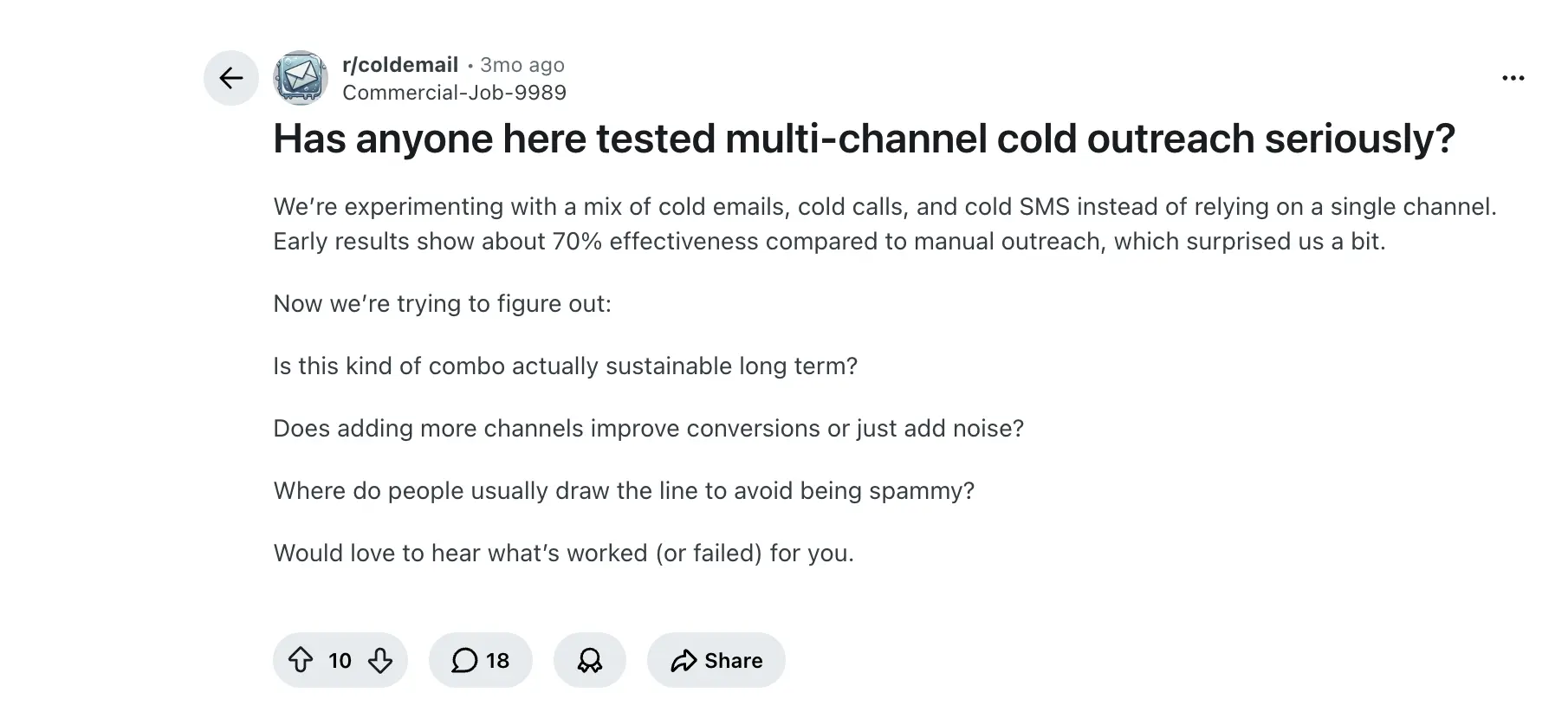
The OP's framing captures where most teams arrive after they've started layering channels: the first results look great, then the question becomes whether the lift is real or just a short-term spike. The 18 answers in the thread cover that ground from multiple angles.
From "What's the best multichannel outreach tool you've used?":
"I've been running cold outreach for about 6 months now, mostly through email, with some LinkedIn outreach mixed in. I'm getting decent response rates, but I feel like I'm leaving opportunities on the table by not coordinating the two channels better."
"The main issue I'm facing is keeping consistent follow-up timing across both channels without manually tracking each conversation."
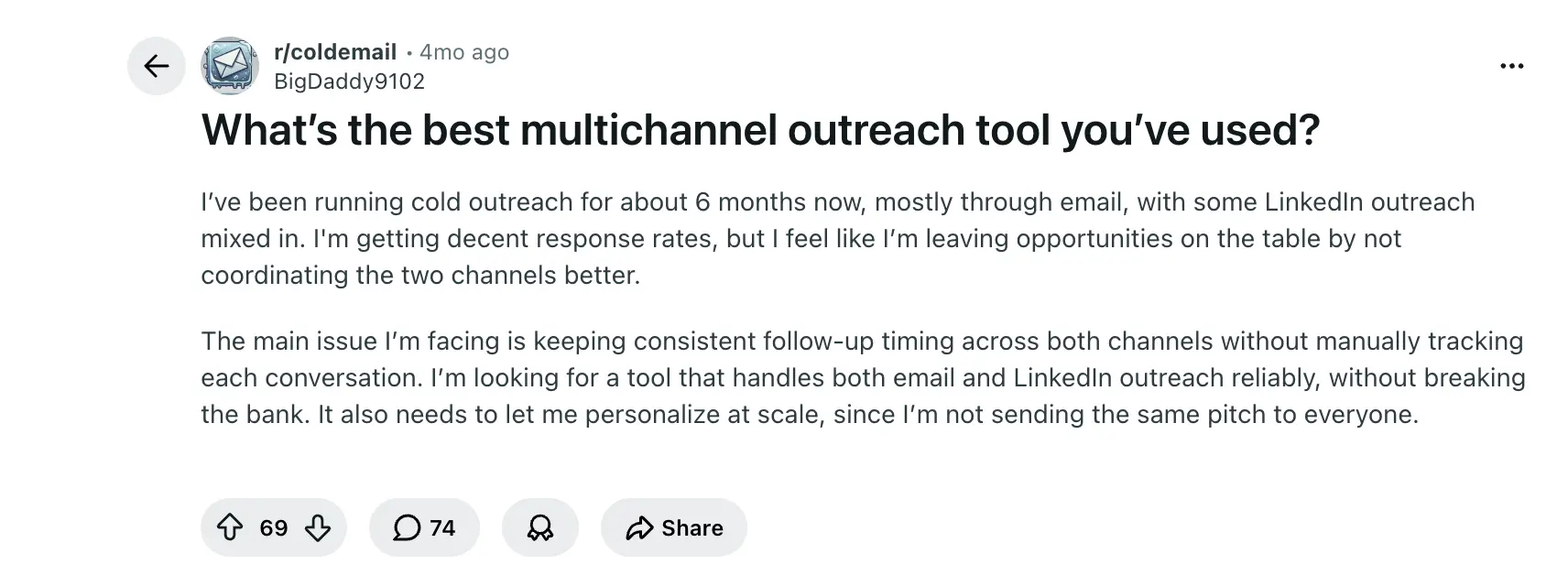
This is the more practical thread, with 74 answers mostly from operators sharing what they actually use to coordinate timing across email and LinkedIn. The top answer recommends combining different tools per channel rather than one tool that tries to do everything.
The pattern across both threads is that nobody runs the same sequence twice. Everyone tunes channel mix, spacing, and copy to their specific ICP, which is why the published guides on this topic disagree on almost every specific number.
The real consensus is at the structural level: combine email with at least one other channel, run the sequence over two or three weeks, and end with a clear close-out touch. Beyond that, your numbers are your numbers.
There are basically three channels you should design a multi-channel sequence around. The rest mostly add complexity without changing the reply rate enough to justify the work.
Email is your anchor in almost every case. The reason is structural, because email gives you the most room to actually make an argument, the most control over timing and volume, and the most established tracking infrastructure to measure what's happening.
Whatever you do on LinkedIn or the phone is going to be read by the prospect against whatever you already said in your first email. The first email basically sets the whole frame for the sequence that follows.
The downside of leaning on email is that it requires deliberate work on the deliverability side (sender warm-up, monitoring, infrastructure choices that aren't fun to think about). That work pays for itself across every campaign you run after it.
LinkedIn does a different job. The highest-leverage move on LinkedIn for cold outreach is usually the connection request rather than the message that comes after it.
A connection request shows up in the prospect's notifications with a face attached to it, which is a different mental experience than receiving an email from an unfamiliar sender. Even if they don't accept the connection you've shown up in their attention briefly.
Once you've sent the connection request, your follow-up email lands against a name they've already seen at least once. The actual LinkedIn DMs work fine as a second touch but they reward short, conversational, useful messages over anything that reads like a cold email pasted into a different interface.
Phone is the underused channel in most modern SDR motions. Phone is the hardest channel emotionally for reps (rejection is real-time, and most people would rather send 100 emails than make 10 calls), and connect rates dropped over the last decade so a lot of teams gave up.
Modern phone work is mostly about timing (early morning, late afternoon, second-line numbers tend to pick up more than primary office lines) and using a 30-second call as a pattern interrupt after the prospect has already seen two of your emails that week.
It's not really a cold call at that point, because they've already seen you in their inbox twice and the call is essentially a confirmation that you're a real person attached to those emails.
Everything else (direct mail, SMS, video DMs, retargeting ads) shows up in cold outreach guides because writers tend to want to fill out a longer list. In practice, these add complexity without moving reply rate enough to matter.
Direct mail can work for high-ACV enterprise targets where the math justifies a $50 swag box, but for the median SDR motion they're a distraction from doing the three primary channels well. Most teams never need a fourth channel and would benefit more from getting the first three to run consistently.
Most multi-channel sequences fail not because the strategy is wrong but because the sequence itself was configured poorly when it was set up. Before launching one, it's worth running it through five quick checks.
A sequence that pushes 100 emails per inbox per day burns the sender reputation that the rest of the sequence depends on, which means you cap inbox throughput before you cap sequence length, every time. Sequences that fail tests four or five should be held back and fixed before they go out, while the first three can usually be tuned after launch without burning the campaign.
This is the actual shape of a sequence that works for most B2B sales motions. Adjust the spacing for your industry and ACV, but the structure tends to hold up across most categories I've watched run this.
Seven touches over 14 days across three channels. If a prospect replies anywhere along the way, the remaining touches drop off.
If they don't reply by Day 14, they go into a nurture segment, not another sequence. Hammering people destroys your sender reputation and your brand, which is a cost that doesn't show up on the dashboard until it's too late to fix.
One contrarian take that's worth flagging: the industry consensus is that 8-12 touches over 14-21 days is the right shape. The math doesn't really support that for most B2B teams, because reply rates decay predictably with each touch and the gains shrink quickly past touch seven or eight.
For median B2B SaaS targets (PMMs, RevOps leads, individual contributors at growth-stage companies), a 5-7 touch sequence over 10-14 days usually outperforms a 10-12 touch sequence on a reply-per-deliverability-cost basis. For enterprise targets with VP-level buyers and longer cycles, the longer cadence earns its keep because the ACV justifies the higher cost.
Default to shorter unless the math says otherwise.
There are four broad categories of tool you'll need to run this. A sales engagement platform for managing sequences and sending email, a prospecting database for verified contact data, a deliverability layer (warm-up, sender rotation, infrastructure), and a CRM for handing off to closers.
The named platforms worth knowing about. Apollo (strong on prospecting depth, lighter on the deliverability side), Outreach (enterprise-grade reporting and analytics, expensive for smaller teams), Salesloft (good coaching and analytics, similar pricing to Outreach), Lemlist (creative-led, lighter overall weight), and Smartlead (cold email infrastructure built for scale, with SmartDialer for phone and Master Inbox for centralizing replies, on flat pricing instead of per-seat).
The full side-by-side comparison of these platforms is here: Best Tools for Multichannel Email Outreach. This article is the strategy layer, that one is the buying decision.
The patterns repeat across teams. They're almost never about the channels themselves.
The most common one is sending the same message across every channel, which defeats the whole point of layering channels in the first place. Each channel does work the others can't (email is where the actual argument lives because you have room to make it, LinkedIn builds familiarity in a different mental space, the phone call interrupts the pattern when emails are getting skipped).
Writing one pitch then broadcasting it across three channels just multiplies your spam factor by three. Prospects notice.
The second pattern is sequences that are too dense in time. A 14-day sequence with seven touches is the upper end of what most B2B prospects will tolerate.
A sequence that hits three times in two days reads as desperation and your sender reputation absorbs the damage. The pacing should look like how a human would actually follow up with someone they wanted to do business with, which is rarely three messages in 48 hours.
The third is reps who abandon sequences after the second touch because they "didn't get a response." Most replies in a sequence arrive between touch four and touch seven, so stopping at touch two leaves most of the available reply volume on the table.
The discipline is finishing the sequence, even when it feels like it's not working at touches two and three.
The fourth is treating LinkedIn like email. Cold-email-style DMs on LinkedIn get ignored, because LinkedIn rewards short, conversational, useful messages that don't have a CTA in the first sentence.
Treat LinkedIn as the place to build familiarity rather than the place to close.
The fifth is ignoring the deliverability cost of multi-channel. The infrastructure work for this is unglamorous (warm-up, account rotation, spam-complaint monitoring, generally treating your sending domain like a production asset that pays the rent).
It tends to get skipped because it's nobody's favorite work, but skipping it is what makes the difference between a sequence that runs reliably for a year and one that craters in month three.
The sixth is optimizing for open rates instead of replies. Open rates are the easiest metric to game and only loosely predict revenue.
A sequence with 60% opens and 0.5% replies is worse than one with 25% opens and 5% replies, and most of the difference comes from targeting and copy rather than channel mix.
The seventh is the handoff problem. A multi-channel sequence builds context with a prospect over two weeks, and that context disappears if the SDR who ran the sequence isn't the person who shows up on the discovery call.
Either keep the SDR in the room for the first call, or write a tight handoff brief that the AE actually reads before the meeting.
You really only need three or four numbers to know if multi-channel is working.
The first is reply rate by channel (not just sequence-level). If email touches generate a 3% reply rate and phone touches generate 8%, that tells you something about where your prospects are actually paying attention.
You can weight the sequence toward what's working.
The second is channel mix performance. Run an email-only sequence in parallel against an email-plus-LinkedIn-plus-phone sequence on the same targeting, compare reply rates after 30 days.
If the multi-channel version isn't outperforming by two to four times, the problem is probably targeting or copy rather than channels.
The third is time-to-first-meeting. Multi-channel sequences tend to shorten this number because earlier touches across multiple channels prime the prospect to say yes faster than a single-channel sequence would.
The fourth is the deliverability cost. Spam complaints and unsubscribes per 1,000 emails sent, tracked weekly.
If those numbers climb above industry benchmarks (roughly 0.1% spam complaints, 0.5% unsubscribes for cold outreach), the sequence is too aggressive regardless of how good the reply rate looks. A reply rate built on burning your sender reputation is a reply rate that disappears in 90 days when the domain reputation catches up.
Worth running a free email deliverability test on your sending domain before scaling up.
A sales prospecting motion that contacts the same prospect across two or more channels (typically email, LinkedIn, and phone) inside a coordinated sequence, instead of relying on a single channel to do all the work.
Multi-channel marketing is brand-level, a company showing up across paid, organic, social, and email to a broad audience.
Multi-channel outreach is 1:1 sales prospecting where a rep contacts a specific prospect across multiple channels to start a conversation. The audience and intent are different.
Usually 14 days with 6-8 touches: a cold email on Day 1, a LinkedIn connection request on Day 3, a follow-up email on Day 5, a phone call on Day 7, a LinkedIn DM on Day 10, a second phone call on Day 12, and a break-up email on Day 14.
The touches build context across channels, with email as the anchor.
Most high-performing sequences land in the 10-21 day range with 5-8 touches.
Shorter than 10 days doesn't give prospects room to respond on their own schedule. Longer than 21 days starts to feel stale and the early touches lose relevance.
Email plus LinkedIn plus phone for most B2B motions, because each channel does work the others can't.
Email is where the persuasion lives, LinkedIn earns familiarity in a different mental space, and the phone touch interrupts the pattern when emails are getting skipped. Adding more channels rarely improves reply rate and usually adds operational complexity.
Not directly, but it scales overall send volume which can stress your infrastructure if it isn't built for the load.
The fix is running sender warm-up, rotating accounts, monitoring spam complaints, and using dedicated email infrastructure when send volume justifies it.
Six to eight is the sweet spot for most B2B motions.
Fewer than five misses most of the available replies (since the widely-cited stat is that 80% of sales need at least five follow-ups), and pushing beyond ten usually drifts into harassment territory.

Founder, StackOptimise
Smartlead's combination of automation, unlimited inboxes, and easy campaign management has completely transformed how we run cold email campaigns.
.jpg)
Founder, Cold Email Hackers

We have about 15 companies and we use Smartlead for all of them.

Founder, DutchSave Media

One of the things I love about using Smartlead is the deliverability feature. If they landed in the bounce or spam folders, we could resolve this quickly.

Co-Founder, Growth Today

I want to continue to use Smartlead to make operations more seamless - the plan is to bring more clients here and build more SOPs.

Founder, FueltoFly

Smartlead listens to the agencies and customers and builds according to what people want, that has really made things easier for us.

Founder, OutboundSync

We build an infrastructure product, and OutboundSync communicates with Smartlead itself. I love the webhook and API. They're really well done and keep getting better.

Founder, Axoleads

With SmartDelivery, you can put all of that in the hands of the tool. It ensures your emails land in inboxes, and by running a simple test, you can see if you're hitting the mark.

Founder, Claygen
Deliverability is the cornerstone of cold email outreach. You could have the best email copy in the world, but if no one is seeing it, it's useless. I really love the feature where you can actually give client accesses to your clients.

Co-Founder, Cymate

I do not want to switch to another software. Pick a solution you trust, stick with it, and keep refining your copy.

CMO, Avalanche Capital

Managing large volumes of emails through multiple inboxes used to be a logistical nightmare. With Smartlead, the process is seamless. We book thousands of discovery calls through cold emails. These campaigns are generating leads at a scale we never thought possible.

Founder, Growth Engine X

We came for the unlimited inboxes, and we stayed for the API. 1.5M cold emails/month, 7,767+ inboxes managed.

Head of Community & Ecosystem, TxtCart

You cannot replace having 10,000 touches with potential clients. When you have that much distribution and reach, you really start to see incredible results. The simplicity of Smartlead made all the difference. It doesn't require you to be a technical wizard.

Founder, Hyperke

Smartlead has been a game-changer for us. It increased our appointment volume, improved ease of use, and offered valuable features. 80% increase in appointments/month, peak of 276 appointments in a single month.

Founder, Kinetyca

Smartlead has been our cold email backbone from day one. The platform evolves constantly, keeping pace with how deliverability and personalization need to work today. 21% overall reply rate, $175K in 4 months for multiple B2B clients.

Founder, Reachflow

Smartlead is centered around deliverability and constantly evolving. Their API is not like any other platform. Smartlead covers all our needs. The focus on core features like deliverability and API integration is unmatched.

CEO, Halfwarm

Our approach to crafting conversational emails led to reply rates that many of my peers thought were unattainable.

Co-Founder, letstrike
We've grown on zero capital, zero marketing, purely cold emailing - and that's the story we love to tell. The best approach is no approach if you can't handle domain meltdown. The second best is something like Smartlead that's built from the ground up for deliverability at scale.

Founder, Fenixtal

Smartlead's white-labeling and automation let us punch above our weight. The 12M euros sales potential? That's what happens when you combine human creativity with Smartlead's precision.

Co-Founder, Digital Creativs

Nine out of 10. Ninety percent of our clients are on Smartlead unless they come in with an existing setup. That's the default.

Co-Founder, BuildingReach

At the end of the day, you have to take a bet on one tool or another. It was a no-brainer taking that bet on Smartlead. We had to even turn down the volume of our marketing campaigns - Smartlead was capable of driving more volume than our sales team was able to fulfill.

Founder & MD, Prospectiv

Since starting the business in January of this year, we've already generated $200K in sales exclusively from cold email. Smartlead has been central to our operations and has exceeded our expectations.

Founder, Growthlynk

There's so much stuff built on top of it. I would be dead if I had to rebuild it with another tool. I can manage hundreds of senders easily. I can send hundreds of thousands of emails.

Founder, Corebits

The platform's HubSpot integration, real-time Slack updates, and advanced campaign customization have been game changers for our business and our clients'.

Founder, Apex Ascension

From day one, we've never used anything else.