


Sign up now and get 50% off on your first month on any plan

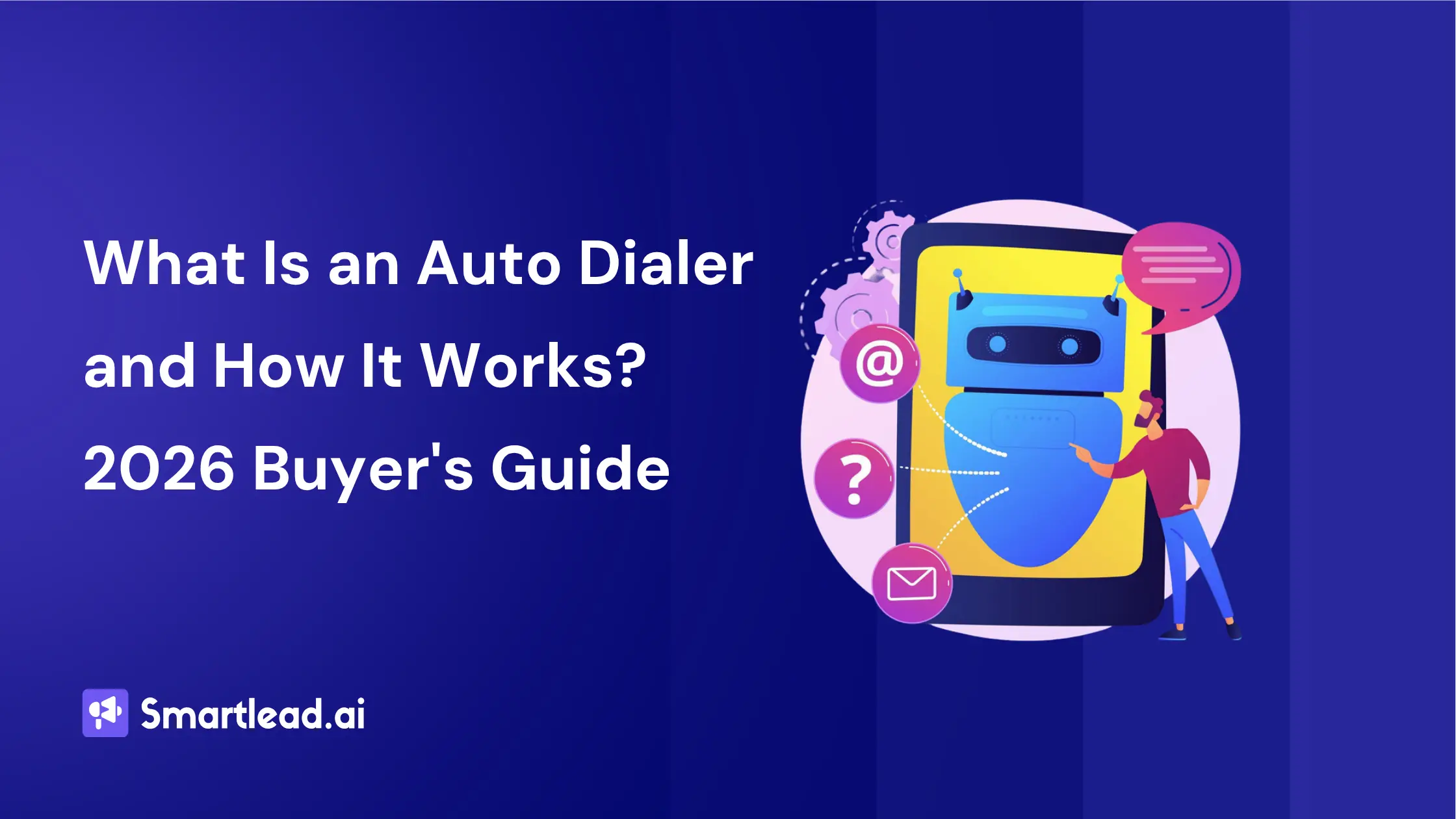
An auto dialer is software that places outbound phone calls for sales or service reps automatically, so the human only steps in once a live person picks up.
It removes the manual dialing, voicemail wait, and number-fumbling that quietly eats half of an SDR's calling hours.
This guide walks through what the tool actually does, the five flavors on the market in 2026, what they cost, and how to pick the one that fits your team.
Here's what I've noticed after watching teams evaluate this category: most SDRs who need an auto dialer already know they need one. What trips them up is the five-category taxonomy vendors use to describe roughly the same problem. Progressive, predictive, power, parallel, AI - all of them are auto dialers. None of them are the same tool.
So let's start clean.
An auto dialer is software that automates the act of dialing outbound phone numbers from a list, so the rep only handles the conversation. Once a call connects to a live person, the system hands it off to the rep along with the lead's profile, history, and any script the team has prepared.
The category is broad. A simple click-to-dial button gets lumped in sometimes, but a real dialer does more than save a single click.
It works through a queue, handles voicemails automatically, logs dispositions, and feeds results back into a CRM or sequence engine.
In B2B sales, this kind of tool is almost always paired with email and LinkedIn outreach so reps can run multi-channel sequences without bouncing between tools.
Why does this matter in 2026 specifically?
Because the math on manual dialing has gotten worse.
A US B2B sales rep spends an average of 35% of their day just trying to reach prospects - on an 8-hour day, that's nearly 3 hours lost to manual dialing, voicemail prompts, and dead numbers. At the same time, it takes an average of 8 call attempts to reach a prospect, yet most reps quit after 2-3. An auto dialer doesn't fix the "quit after 2-3" problem, but it does make sure that hitting 8 attempts is no longer a heroic act - it's just how the queue works.
It pulls phone numbers from a list, places the calls automatically, filters out voicemails and dead numbers, and routes live answers to an available rep. The plumbing looks like this:
You upload a CSV, pull a CRM segment, or feed leads from an existing sequence. Each record needs a phone number, and most dialers check numbers against a do-not-call list before queuing them. The better tools, like SmartDialer, auto-enrich missing phone numbers at the moment of upload so you're not manually fixing records before you can start calling.
The dialer orders the queue by priority, time zone, or sequence step. A good queue surfaces leads who are callable right now - between 8 AM and 8 PM in their local time - and pushes the rest down. This alone eliminates one of the dumbest ways reps waste time: dialing into voicemail at 7 AM because the queue wasn't timezone-aware.
Depending on the type (progressive, predictive, power, parallel), the dialer either waits for the rep to be free, dials one at a time, or fires several lines at once and connects the first pickup. This is where the category names come from. More on each below.
Modern dialers detect answering machines, busy signals, and disconnected numbers, then handle them automatically. Voicemail drop is a common feature - one click leaves a pre-recorded message while the dialer moves to the next number. Power dialers eliminate 20-40 seconds of dial time per call, moving reps from 20-25 manual dials per hour to 45-60 dials per hour.
When a real person answers, the dialer connects the rep and surfaces the lead's email history, last activity, and call script in the same window. This is the difference between a sequence-native dialer and a standalone calling tool. With SmartDialer, every email the lead has received and every reply they've sent is visible on the right side of the screen during the call. The rep doesn't need to pull up a second tab.
After the call, the rep picks a disposition (connected, voicemail, no answer, callback) and a queue action. The dialer logs the outcome and decides what happens next - advance the sequence, retry tomorrow, or remove from the list. The smarter the dialer, the more of this happens without the rep clicking through menus.
There are five common types in 2026. Each handles pacing and the rep-to-call ratio differently. Picking the right one depends on your call volume, list quality, and how regulated your industry is.
A progressive dialer places one call at a time per rep, but only when the rep is free. It waits for the previous call to wrap up before dialing the next. The rep sees the lead's profile a beat before the call connects, so there's no "who is this?" moment when a prospect picks up.
Progressive dialing is the safest type for B2B. The rep is always ready, there are no "dropped" calls (calls a prospect picks up but no rep is available for), and compliance under rules like TCPA is straightforward. The trade-off is throughput. You're capped by how fast the rep can wrap up the previous call.
Best for: B2B SDRs running consultative outbound on lists of 50 to 200 numbers a day. Also the default pattern for regulated industries.
A predictive dialer uses an algorithm to dial multiple numbers per rep, predicting when the current call will end so the next one connects right as the rep frees up. The math is borrowed from call center operations. Dial just enough ahead to keep reps on calls 80% of the time without dropping any.
The upside is volume. The downside is risk. If the algorithm dials too aggressively and there's no rep free when someone answers, the call gets abandoned. Abandoned-call rates above 3% run afoul of FCC regulations, and predictive dialers trigger 5-15% abandoned-call rates on B2B mobile lists - well above the federal cap. For B2B in 2026, this risk profile is rarely worth it. And TCPA class actions filed through mid-2025 were up nearly 95% year-over-year, with statutory damages running $500 to $1,500 per unlawful call.
Best for: High-volume B2C contact centers and large outbound SDR pods with 10+ concurrent reps where the math on abandoned calls stays manageable.
A power dialer calls one number at a time, queued up automatically from a list, with no manual click between calls. Think of it as the rep pressing one button and the dialer just keeping numbers flowing until the queue runs dry.
Power dialing sits between manual click-to-dial and predictive. It's faster than manual but lower-risk than predictive. Reps using a power dialer can increase call volume by 3-4x and improve connect rates by up to 32%. It's the dominant pattern for B2B sales teams in 2026 because it's compliance-friendly, straightforward to set up, and pairs cleanly with sequence tools.
Best for: B2B SDRs and AEs who want speed without the abandoned-call risk of predictive. The safe default for most outbound teams.
A parallel dialer places multiple calls at the same time for a single rep, then routes the first one to answer to that rep while dropping the rest. It's the most aggressive form of auto dialing built for B2B prospecting, and tools like Nooks and Orum built their reputations on it.
The math works because most B2B numbers don't pick up.
If your connect rate is 5%, dialing 5 lines in parallel gives you roughly a 23% chance that at least one answers on each round.
A parallel dialer can triple live conversations per hour at the same rep effort - the most mechanical lever in cold calling. The trade-off is that TCPA compliance gets more delicate, and most parallel dialers limit to 3-5 lines per rep for that reason.
Best for: Outbound SDRs grinding through 300+ dials a day in B2B verticals where call volume is the primary bottleneck. See the Parallel Dialer Guide for details.
An AI dialer adds a layer of intelligence on top of any of the dialer types above. It transcribes calls in real time, generates post-call summaries, drops voicemails with one click, surfaces coaching prompts during the call, and feeds dispositions back to the sequence engine automatically.
The "AI" part isn't the dialing. It's everything around the dialing. Tools like Nooks, Orum, and Smartlead's SmartDialer all converge on this pattern. A power or parallel dialer underneath, with AI handling the busywork (note-taking, summarizing, coaching) so the rep just talks.
Best for: Teams that want the speed of power or parallel dialing plus the coaching and reporting layer on top. This is where most 2026 product launches are landing. See the AI Dialer Guide for a deeper look.
"Auto dialer" is the umbrella category. "Power dialer" is one specific type that dials one number at a time per rep, automatically queued. So every power dialer fits under the broader category, but not every auto dialer is a power dialer.
Here's how the two terms map in practice:
If someone says they need an auto dialer, they probably want a power dialer - with maybe a parallel dial mode for high-volume days. The category overlap is wide enough that vendors use the words interchangeably in their marketing. When in doubt, ignore the label and ask: "Does this dial one number at a time or multiple?" That single question reframes the entire comparison.
Auto dialer pricing in 2026 ranges from about $30 per user per month at the low end to over $200 per user per month for AI-heavy parallel tools. The spread reflects feature depth more than dialer type alone.
Some specific vendor anchors for 2026:
The hidden cost most teams miss is minutes and numbers. Standalone dialers charge per minute and per phone number on top of the seat fee.
A 5-rep team running 200 dials a day can easily add another $300 to $800 a month in usage fees on top of the seat price.
Bundled platforms tend to roll this into the plan, which is why the all-in cost usually favors them at any team size above 2 or 3 reps.
The best fit for a small business depends on whether you're calling B2B prospects, supporting customers, or running mixed outbound. For most small B2B sales teams in 2026, a power dialer with sequence integration beats a standalone parallel tool on cost and complexity.
Three patterns that work for small teams:
Pick a sequence tool with a built-in dialer so you're not stitching two stacks together. SmartDialer is built for this case. The phone call step lives in the same sequence as your email steps, so the AI has full context - what was sent, what was replied to, where the lead is in the funnel - before you even pick up.
A parallel dialer pays for itself if list quality is decent. Nooks or Orum are common picks for pure-volume shops. If you'd rather run one platform instead of two, SmartDialer includes parallel dialing inside the same multi-channel workflow.
A simple power dialer like Aircall or CloudTalk is enough. You don't need full multi-channel sequencing for service callbacks - just reliable connection and basic logging.
Small businesses get burned most often by per-seat pricing and minute fees. A $79 per user dialer turns into $1,500 a month at 15 reps, and parallel dialer minutes can rival the seat cost itself. Flat-priced or bundled tools win the math at most team sizes under 25 reps.
Most dialers are bolt-ons. You run your email sequences in one tool, your calling in another, and then you manually reconcile what each prospect has seen before every call. SmartDialer is built differently - and I think it's worth explaining why that matters, not just what the features are.
SmartDialer sits inside the same sequence as your email steps.
A Smartlead campaign can have an Email step, a Wait, a Phone Call step, another Wait, another Email - all driven by the same sequence engine.
No other major outbound tool in 2026 ships this as a native feature. The practical effect is that when your rep opens a call, they already know exactly what the prospect has read and replied to. The AI isn't guessing at context. It has it.
Here's what's included in the stack:
The honest trade-off: SmartDialer's parallel dialing is part of a broader outbound platform, not the headline feature.
If your team does nothing but cold call - no email, no LinkedIn, no multi-channel sequences - Nooks and Orum have a longer track record on raw parallel dialing volume.
But if you're already using Smartlead for email (or plan to), the calling step lives in the same place you already work, the AI has real context, and there's no per-seat dialer fee on top of your existing plan.
Let's anchor this with real numbers, because the "is cold calling still worth it" debate comes up every quarter and deserves a factual answer.
Average B2B cold calling success rates in 2025-2026 sit around 2.3-2.5%, roughly 1 meeting per 40-45 dials.
Top teams hit 5-8% or higher. That gap is the entire business case for investing in a dialer, a good list, and a coaching layer.
The average rep isn't losing because they're bad at cold calling. They're losing because they're only getting 8-10 meaningful conversations a day on manual dialing.
An auto dialer changes the volume side of the equation immediately.
New SDRs typically manage 60-80 dials per day.
Mid-level reps with good scripts hit 80-100. SDRs using power dialers reach 100-120 without rushing.
Research from Velocify found that sales reps complete 92% more calls per hour using automated dialing versus manual - effectively doubling dialing productivity.
On the connect rate side: mid-morning windows from 10-11 AM generate 31% higher connect rates than early morning or late afternoon, and Tuesday and Wednesday consistently outperform other weekdays by 28%.
A timezone-aware dialer that surfaces these timing signals isn't just a feature - it's the difference between calling into voicemail and actually reaching people.
The pattern that separates average teams from top performers is consistent: it's not the dialer.
Reps lose 27.3% of their selling time to bad contact data, and poor data quality costs organizations an average of $12.9 million per year.
If your list is stale, the dialer helps you call the wrong people faster. Clean data plus a good dialer plus a multichannel context is what actually moves connect rates from 3% toward 8%.
Yes, with caveats worth understanding before you buy.
These tools are legal in the United States under TCPA as long as you respect calling hours, honor do-not-call lists, and keep abandoned-call rates under 3%. Predictive and parallel dialers carry the most compliance weight because they dial multiple lines per rep. Most B2B SDR teams stay safe with progressive or power dialers operating during business hours.
The risk has real teeth. TCPA statutory damages run $500 to $1,500 per unlawful call, with no aggregate cap - a campaign of 100,000 messages sent without proper consent could result in exposure exceeding $150 million in a class action. And that's not theoretical. TCPA class actions filed through mid-2025 were up nearly 95% year-over-year.
SmartDialer includes callable-hour indicators tied to the lead's local timezone and a unified block list across email and phone. That handles the mechanics of compliance. The policy side - your DNC process, consent documentation, internal review cadence - sits with you.
There's a version of this section that just lists features. You've already read those. What's more useful - and more honest - is what the people running real outbound programs say after actually using the stack.
Hugo co-founded Trigify, a sales trigger data platform that helps teams reach prospects at exactly the right moment based on live signals - funding rounds, job changes, LinkedIn activity. His team had the full multichannel motion running before SmartDialer. Emails, LinkedIn, sequences, calls. And something still felt off.
Here's how he described it:
"Cold calling isn't dead. Calling without context is. At Trigify we learned that the hard way. We were doing what most outbound teams do. Sending the emails. Engaging on LinkedIn. Running sequences. And yes, making calls. But something always felt off. We'd see signals everywhere. By the time we actually picked up the phone, the moment was gone.
Implementing SmartDialer inside Smartlead was a huge shift for us. Pipeline up nearly 200%. Close rate up 60%. When activity signals interest, that's when the call happens. Email - LinkedIn - Call - AI follow-up - CRM - Insights. This is what proper multichannel outbound looks like. If your calling lives in a separate workflow, you're killing your own pipeline."
Read the full post on LinkedIn
That 200% pipeline figure isn't from a dialer feature. It's from timing. Calling when the signal is live instead of when the queue gets there.
Matteo engineers full GTM systems for growth-stage B2B technology companies. His team runs over 1 million outbound emails per month for partners through Smartlead. The problem he identified wasn't the volume. It was the gap between intent and action.
In his own words:
"Your rep just got a reply from a prospect. How many tools do they touch before they are actually on the call? For most teams it is at least three. The sequence tool where the reply came in, the dialer they switch to, and whatever they use to piece together the conversation history before dialing. By the time they are speaking to the prospect, the context that created the intent is sitting in another tab.
Before SmartDialer, this was the exact gap we were dealing with inside our own Smartlead workflows. The reply would come in, the intent was right there, and then the rep had to leave to act on it somewhere else.
SmartDialer keeps the entire motion inside Smartlead. Reply comes into Master Inbox, rep clicks Call Lead directly from the thread. Email history stays visible on screen during the call, no tab switching to reconstruct what was said. Call records automatically, no separate transcription tool needed. Transcript and call log sit in the same timeline as the emails and sequences once the call ends.
Your reps still have to show up prepared and actually use the context sitting in front of them. But at least your stack stops working against them at the exact moment the prospect is ready to talk."
Read the full post on LinkedIn
The phrase worth holding onto: "your stack stops working against them at the exact moment the prospect is ready to talk." That's the design problem a standalone dialer doesn't solve and a sequence-native one does.
It's worth stepping back for a second, because the auto dialer conversation in 2026 isn't really about dialers. It's about where manual rep time is actually going, and what happens when you reclaim it.
The predictive dialer software market was valued at $1.03 billion in 2024 and is projected to reach $12.19 billion by 2028 (Grand View Research).
That growth rate doesn't happen in a category that's marginal.
What's driving it is the convergence of three things that weren't true at the same time five years ago: AI transcription is accurate enough to be useful at scale, remote SDR teams need tooling that doesn't require an on-site PBX, and outbound teams have accepted that phone is one step in a sequence, not a standalone channel.
That last point is the one most teams are still adjusting to.
The teams that treat calling as a standalone channel - a list, a dialer, a CRM sync on Friday - consistently underperform the teams that treat every call as a step in a conversation that's been building through email and LinkedIn.
The auto dialer is the mechanism. The sequence context is what makes it work.
Here's what the numbers say about where things stand:
The pattern is consistent across every data source: the ceiling isn't in how fast you can dial. It's in the quality of the context you bring to each conversation, and how quickly you can route the right follow-up action after the call ends. That's the problem a sequence-native dialer solves. Everything else is just picking your volume.
Yes, with caveats.
These tools are legal in the US under TCPA as long as you respect calling hours, honor do-not-call lists, and keep abandoned-call rates under 3%. Predictive and parallel dialers carry the most compliance weight.
Most B2B SDR teams stay safe with progressive or power dialers operating during business hours. For more, see the compliance section above.
The first is the umbrella category. A power dialer is one type that dials one number at a time per rep with no abandoned-call risk.
Predictive and parallel tools also fall under the same umbrella, but they dial multiple lines at once. In casual usage the two terms get used interchangeably - what matters is asking which specific subtype a vendor is shipping.
Most modern dialers integrate with HubSpot and Salesforce to sync call activity, dispositions, and notes back to the lead record. Integration depth varies significantly. Sequence-integrated dialers like SmartDialer also write to Smartlead's own lead timeline and surface call activity in the same view as email history - no manual sync required.
Yes. Modern dialers detect voicemails using answering-machine detection (AMD), which listens for the tone and pause pattern that signals a recorded greeting. Detection isn't perfect - false positives may drop 1 to 3% of live calls - but voicemail drop (leaving a pre-recorded message automatically) makes the workflow much faster either way. SmartDialer includes both voicemail detection and voicemail drop.
A progressive dialer typically gets a B2B SDR to 80-120 dials per day. A power dialer pushes that to 100-150. A parallel dialer can take the number to 300-600 dials per day. The connect rate stays roughly constant at 5-10% of B2B dials, so the higher dial counts translate directly to more live conversations per day.
Yes, if the team makes more than 30 to 50 outbound calls a day. A US B2B sales rep spends an average of 35% of their day just trying to reach prospects without a dialer. An automated tool reclaims most of that time. For teams under 30 calls a day, click-to-dial inside your CRM is usually enough.
The cheapest option is a bundled platform where the dialer is included with the outbound stack. Smartlead bundles SmartDialer starting at $39 per month with no per-seat dialer fee. Standalone power dialers like CloudTalk start around $25 per user per month but charge separately for minutes and numbers. The total-cost picture almost always favors bundled tools at any team size above 1 rep.
If you've read this far, you're probably trying to make one of three decisions.
"We need to move faster." Your reps are manually dialing and you know they're losing 30-40% of their calling hour to dead time.
Any auto dialer - even a basic power dialer - fixes this immediately. If you're already on Smartlead for email, SmartDialer is the path of least resistance: same platform, no per-seat fee, parallel dialing included.
"We need more context on calls." Your reps are calling but the conversations aren't landing because they don't know what the prospect has seen or where they are in the funnel. A standalone dialer won't fix this. A sequence-native dialer like SmartDialer does, because the call opens with the full email and LinkedIn history visible on screen.
"We need to scale without scaling headcount." Your team is hitting 150-200 dials per day and you're looking at parallel dialing to push that to 400+. SmartDialer includes dialing inside the multi-channel workflow.
The right answer is almost always: start with the tool that lives inside the workflow you're already using. The best dialer is the one your reps actually open every morning. For most teams already running Smartlead sequences, that's SmartDialer.
Join us to elevate your outreach!
Founder, StackOptimise
Smartlead's combination of automation, unlimited inboxes, and easy campaign management has completely transformed how we run cold email campaigns.
.jpg)
Founder, Cold Email Hackers

We have about 15 companies and we use Smartlead for all of them.

Founder, DutchSave Media

One of the things I love about using Smartlead is the deliverability feature. If they landed in the bounce or spam folders, we could resolve this quickly.

Co-Founder, Growth Today

I want to continue to use Smartlead to make operations more seamless - the plan is to bring more clients here and build more SOPs.

Founder, FueltoFly

Smartlead listens to the agencies and customers and builds according to what people want, that has really made things easier for us.

Founder, OutboundSync

We build an infrastructure product, and OutboundSync communicates with Smartlead itself. I love the webhook and API. They're really well done and keep getting better.

Founder, Axoleads

With SmartDelivery, you can put all of that in the hands of the tool. It ensures your emails land in inboxes, and by running a simple test, you can see if you're hitting the mark.

Founder, Claygen
Deliverability is the cornerstone of cold email outreach. You could have the best email copy in the world, but if no one is seeing it, it's useless. I really love the feature where you can actually give client accesses to your clients.

Co-Founder, Cymate

I do not want to switch to another software. Pick a solution you trust, stick with it, and keep refining your copy.

CMO, Avalanche Capital

Managing large volumes of emails through multiple inboxes used to be a logistical nightmare. With Smartlead, the process is seamless. We book thousands of discovery calls through cold emails. These campaigns are generating leads at a scale we never thought possible.

Founder, Growth Engine X

We came for the unlimited inboxes, and we stayed for the API. 1.5M cold emails/month, 7,767+ inboxes managed.

Head of Community & Ecosystem, TxtCart

You cannot replace having 10,000 touches with potential clients. When you have that much distribution and reach, you really start to see incredible results. The simplicity of Smartlead made all the difference. It doesn't require you to be a technical wizard.

Founder, Hyperke

Smartlead has been a game-changer for us. It increased our appointment volume, improved ease of use, and offered valuable features. 80% increase in appointments/month, peak of 276 appointments in a single month.

Founder, Kinetyca

Smartlead has been our cold email backbone from day one. The platform evolves constantly, keeping pace with how deliverability and personalization need to work today. 21% overall reply rate, $175K in 4 months for multiple B2B clients.

Founder, Reachflow

Smartlead is centered around deliverability and constantly evolving. Their API is not like any other platform. Smartlead covers all our needs. The focus on core features like deliverability and API integration is unmatched.

CEO, Halfwarm

Our approach to crafting conversational emails led to reply rates that many of my peers thought were unattainable.

Co-Founder, letstrike
We've grown on zero capital, zero marketing, purely cold emailing - and that's the story we love to tell. The best approach is no approach if you can't handle domain meltdown. The second best is something like Smartlead that's built from the ground up for deliverability at scale.

Founder, Fenixtal

Smartlead's white-labeling and automation let us punch above our weight. The 12M euros sales potential? That's what happens when you combine human creativity with Smartlead's precision.

Co-Founder, Digital Creativs

Nine out of 10. Ninety percent of our clients are on Smartlead unless they come in with an existing setup. That's the default.

Co-Founder, BuildingReach

At the end of the day, you have to take a bet on one tool or another. It was a no-brainer taking that bet on Smartlead. We had to even turn down the volume of our marketing campaigns - Smartlead was capable of driving more volume than our sales team was able to fulfill.

Founder & MD, Prospectiv

Since starting the business in January of this year, we've already generated $200K in sales exclusively from cold email. Smartlead has been central to our operations and has exceeded our expectations.

Founder, Growthlynk

There's so much stuff built on top of it. I would be dead if I had to rebuild it with another tool. I can manage hundreds of senders easily. I can send hundreds of thousands of emails.

Founder, Corebits

The platform's HubSpot integration, real-time Slack updates, and advanced campaign customization have been game changers for our business and our clients'.

Founder, Apex Ascension

From day one, we've never used anything else.